Clinicians › Wrist
Intersection Syndrome
Proximal (and distal) intersection syndrome: differentiation from de Quervain's, imaging, and conservative-first management with rare release.
For patients: a plain-language version of this topic is available. See the patient guide.
Overview
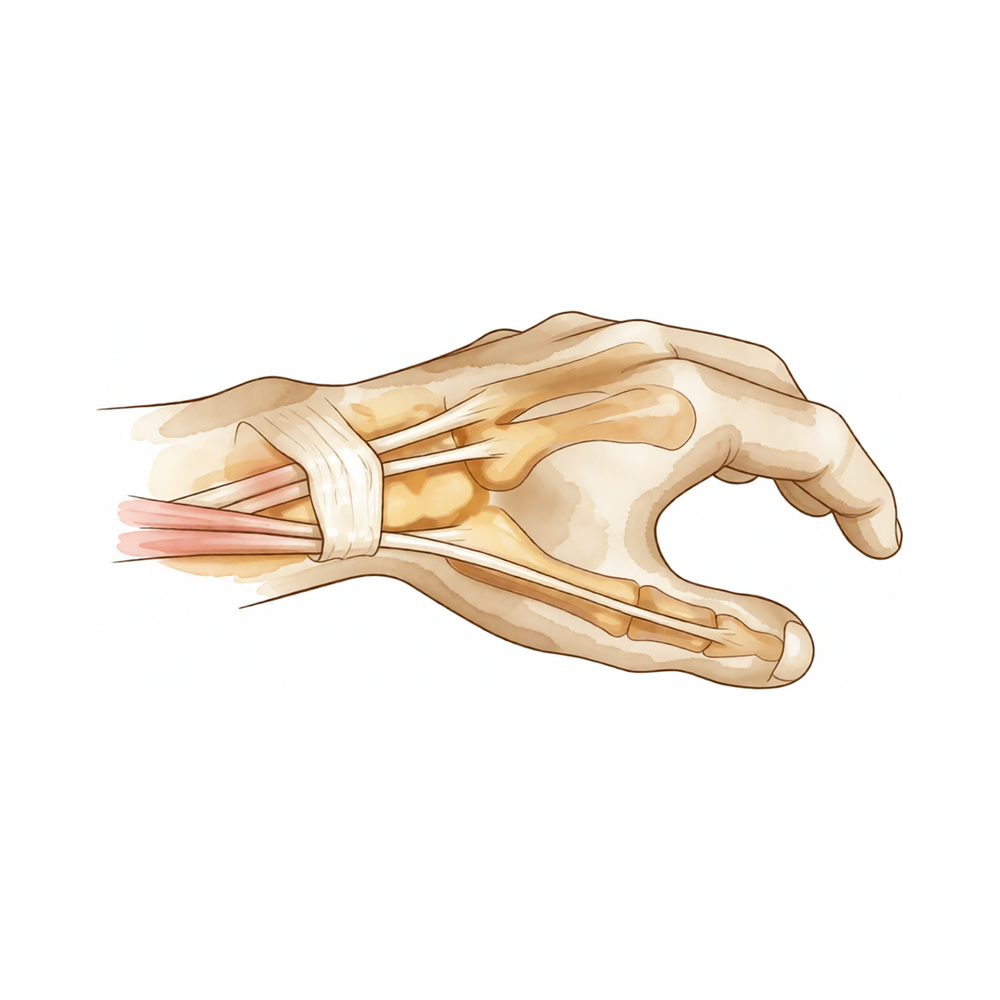
Intersection syndrome is a painful condition of the distal forearm characterized by the compression of the extensor carpi radialis longus and extensor carpi radialis brevis tendons by the muscle bellies of the abductor pollicis longus and extensor pollicis brevis [2]. This primary site of pathology is distinct from primary pathology in the second dorsal compartment [2]. The condition typically presents with pain at the distal intersection of the first and second dorsal compartments, often resulting from repetitive wrist extension and thumb abduction.
Prolonged pain in distal intersection syndrome may lead to tendon attrition, indicating a need for surgical treatment [1]. While conservative management is often the initial approach, persistent symptoms that result in structural tendon damage necessitate operative intervention to address the underlying compression and prevent further degeneration.
Diagnostic criteria for upper limb disorders in epidemiological research vary from study to study, leading to widely differing prevalences of upper limb disorders [5]. This variability complicates the standardization of diagnosis and outcome reporting. Furthermore, failure of an operation in De Quervain tenosynovitis is due to anatomical variations, the involvement of the radial superficial nerve, and the ignoring of another syndrome in the proximity [17]. Surgeons must carefully differentiate intersection syndrome from adjacent pathologies such as De Quervain tenosynovitis to avoid diagnostic errors and subsequent surgical failure.
Anatomy & Pathophysiology
Anatomical Structures
The wrist constitutes the anatomic region between the forearm and the hand, encompassing the distal radioulnar, radiocarpal, and ulnocarpal joints along with the eight carpal bones [62]. The carpal bones are organized into a proximal row comprising the scaphoid, lunate, triquetrum, and pisiform, and a distal row consisting of the trapezium, trapezoid, capitate, and hamate [62]. The radiocarpal joints form through the articulation of the distal radius with the scaphoid and lunate via their respective concave facets, while the triquetrum articulates on the triangular fibrocartilage [62]. The distal ulnar convexity articulates at the lesser sigmoid notch of the distal radius [62]. The triangular fibrocartilage attaches to the base of the ulnar styloid, separating the hyaline cartilage–covered ulnar head from the styloid [62].
The chondroligamentous supports attaching the distal radius and ulnar side of the carpus to the distal ulna are designated as the triangular fibrocartilage complex (TFCC) [62]. The TFCC includes the ulnar collateral ligament, the dorsal and volar radioulnar ligaments, the articular disc, the meniscal homologue, the extensor carpi ulnaris sheath, and the ulnolunate and ulnotriquetral ligament [62]. In the interosseous space, the interosseous membrane connects the shafts of the radius and ulna [66]. The central portion of this membrane is thickened and plays a significant role in force transmission between the radius and ulna [66]. On the dorsal surface of the wrist, six dorsal compartments contain the wrist and digital extensor tendons [66].
The extraosseous blood supply to the carpus is provided by terminal branches of the radial, ulnar, and anterior interosseous arteries, which form three dorsal and three palmar transverse arterial arches with longitudinal connections [72]. The dorsal intercarpal arch is the largest of the dorsal arches and is located between the proximal and distal carpal rows [72]. This arch supplies the distal carpal row and, through anastomoses with the radiocarpal arch, the lunate and triquetrum [72].
Pathophysiology
Intersection syndrome was first described by Velpeau in 1841 [13]. Howard reported 15 cases of intersection syndrome in 1937 [13]. In 1951, Thompson et al. treated 419 patients with intersection syndrome in an industrial area of England [13]. Brooker reported six cases of ECRL tenosynovitis of the forearm but did not recognize that this condition and intersection syndrome were the same disease [13]. Dobyns et al. introduced the name “intersection syndrome” [13]. Except for Brooker, all authors believed that the basic pathology of intersection syndrome was located at the point where the muscle bellies of the APL and EPB cross the tendons of the ECRL and ECRB [13]. However, operative experience has found that the basic and consistent pathologic abnormality in intersection syndrome is tenosynovitis of the common wrist extensors in the second dorsal compartment [13].
Because the second dorsal compartment is encased in a tight compartment, tenosynovitis in this area does not present with physical findings in this area but proximal to it [13]. Similarly, tenosynovitis of the flexors of the wrist presents as pain and swelling proximal to the carpal tunnel [13]. On examination, the flexor aspect of the carpal tunnel reveals no tenderness or swelling despite intense synovitis within the carpal tunnel [13]. Tenosynovitis of the digital flexor sheath presents with swelling and tenderness that are not pronounced over the flexor sheath but proximal to it [13]. The synovitis within the digital flexor sheath is not appreciated until the time of operative decompression [13].
Tendinitis can occur due to tension overload or shear stress [9]. Overuse is defined as a level of repetitive microtrauma that exceeds the ability of the tissue to adapt [9]. At the molecular level, tendon failure occurs due to stretching of collagen, the chief component of the structure [9]. Up to 4% of elongation is well tolerated, and no tissue damage occurs [9]. Between 4% and 8% of elongation, the collagen cross-links rupture, and collagen fibers slide past one another [9]. Macroscopic failure of the tendon occurs when greater than 8% elongation occurs, and the fibers rupture [9]. Tension overload can occur in the muscle, at the musculotendinous junction, in the tendon substance itself, or at its attachment to bone [9]. Tendons adapt to applied loads according to the Wolff law, which involves an increase in collagen content and cross-linking [9].
Shear stress can occur where tendons pass in close proximity to a fixed structure [9]. Tenosynovial tissue surrounds tendons at points where they pass through tunnels or around bony prominences to lubricate and protect these structures [9]. The process involved in the pathogenesis and natural history of tendinitis can be divided into four stages: inflammatory, proliferative, maturation, and fibrosis [9]. The inflammatory response to microtrauma is characterized clinically by pain, swelling, increased temperature, and tenderness at the site [9]. Prolonged pain in distal intersection syndrome may lead to tendon attrition [1].
Classification
Historical Recognition: Brooker reported six cases of extensor carpi radialis longus tenosynovitis of the forearm without recognizing the condition as intersection syndrome [13].
Pathologic Basis: The basic and consistent pathologic abnormality in intersection syndrome is tenosynovitis of the common wrist extensors in the second dorsal compartment [13].
Clinical Presentation: Tenosynovitis in the second dorsal compartment does not present with physical findings in that area but presents proximal to it due to the tight compartment [13].
Distal Variant: Distal intersection syndrome may lead to partial attritional changes of the extensor carpi radialis brevis tendon [1].
Clinical Presentation
Because the second dorsal compartment is encased in a tight compartment, tenosynovitis in this area does not present with physical findings in that specific area but rather proximal to it [13].
Investigations
Plain radiography: In the clinical setting, obtaining a true lateral view of the wrist is often not feasible [31]. Diagnostic criteria for upper limb disorders in epidemiological research vary significantly between studies, resulting in widely differing prevalence rates [5].
MRI: MRI is the modality of choice for imaging radiographically occult fractures of the hand and wrist [68]. Its primary advantages over CT and radiography include improved tissue characterization, particularly for soft tissues such as ligamentous structures and synovium, and the absence of ionizing radiation [68]. For analyzing interosseous, intrinsic, and extrinsic ligament insertions, a static magnetic field strength of at least 1.5 T using a dedicated wrist coil is recommended [75]. Higher magnetic field strengths yield a higher signal-to-noise ratio with shorter scan times [75].
Specific imaging protocols are required for optimal visualization. The volar extrinsic, SL interosseous, dorsal intercarpal, and LT ligaments are best visualized using 1 mm slices with no interslice gap in the coronal plane [75]. The DRC and intercarpal ligaments are best viewed on both coronal and sagittal images [75]. Oblique axial views along the longitudinal axes of these ligaments allow further analysis, especially when an injury is suspected [75]. Concomitant cartilage-sensitive imaging is integrative to influence assessment and surgical management, as cartilage integrity directly impacts clinical and surgical decisions [75]. Real-time MRI has been used to investigate dynamic instabilities, although its routine use in clinical practice remains to be further determined [75].
MRI provides high-resolution images of the elbow and wrist, best obtained with surface coil technique and high field systems [77]. A common indication in the wrist is the evaluation of intrinsic carpal ligaments [77]. With proper technique, injuries to the triangular fibrocartilage complex (TFCC) can be demonstrated; perforations appear as linear defects or gaps filled with hyperintense fluid on coronal gradient-echo or T2-weighted pulse sequences [77]. The addition of arthrographic contrast improves the visualization of carpal ligaments on MR images [77].
MRI is useful in detecting additional marrow abnormalities in osteonecrosis, such as in the lunate in Kienböck disease or in the scaphoid after fracture [77]. Asymmetry of marrow signal in the proximal and distal fragments of a fractured scaphoid is suggestive of proximal pole ischemia [77]. MRI currently has a limited role in the evaluation of carpal tunnel syndrome, although axial imaging with T2 weighting can clearly display masses within the confines of the carpal tunnel as well as edema and swelling of the median nerve [77]. Tenosynovitis and tendon injuries in the wrist and hand can also be assessed with MRI [77]. Furthermore, MRI provides earlier detection of synovitis and erosive bone changes associated with rheumatoid arthritis than do radiographs [77].
Regarding specific pathologies, MRI does not differentiate between traumatic and degenerative tears of the triangular fibrocartilage complex [103]. MRI determination of posterior interosseous nerve position is reliable and consistent with prior cadaveric study [105]. In a specific case, MRI helped to differentiate between affected and healthy tendons, demonstrated the exact location of the pathology, and directed the site of surgical decompression [52].
Magnetic Resonance Neurography: Magnetic resonance neurography should be seen as a powerful adjunct rather than a stand-alone diagnostic test that complements clinical exams and electrodiagnostic tests in routine practice [24]. The main benefit is providing anatomical correlation and pinpointing nerve pathology [24]. A significant limitation is the lack of standardized imaging thresholds, especially in the subjective assessment of nerve hyperintensity [24]. Independent evaluations by two musculoskeletal radiologists with a consensus session prior to grading ensured consistent interpretation and led to substantial to almost perfect interrater agreement across all imaging features [24]. Multicenter collaboration will be essential to establish consistent diagnostic benchmarks for magnetic resonance neurography [24].
CT: CT scanning enables the 3D analysis of carpal dysfunction [75]. By adding motion in real time (4D CT), this technique may hold promise in the future to potentially quantify the location and degree of injury noninvasively and help surgeons plan their surgical treatment [75]. A study demonstrated a precise correspondence between CT and operative findings in 11 cases with flexion contracture of the forearm muscles [97]. This technique can also clearly identify normal anatomic structures thought to have been injured [50].
Dynamic Imaging: Dynamic fluoroscopy shows abnormal motion between the scaphoid and lunate as well as changes in the kinematics of the midcarpal joint [75]. Live imaging shows whether the DISI is reducible, giving the physician valuable information as the treatment is planned [75]. The triquetrum-hamate relationship normally changes from full engagement in ulnar deviation to complete disengagement in radial deviation; in SLD patients with DISI, this joint remains permanently engaged [75].
Other Considerations: Arthroscopy is considered by many to be the diagnostic intervention of choice for determining the degree of injury to the wrist and can assess the condition of the cartilage, ability to reduce the carpus, and any other associated injuries [75]. The degree of intrinsic and extrinsic ligament injury can be identified from arthroscopic evaluation [75]. If signs suggestive of compartment syndrome develop after operation, prompt intracompartment pressure measurements are indicated [6].
Treatment
Non-Operative
Conservative techniques address all structures potentially involved in the syndrome to reduce symptoms and improve functionality [4]. Treatment modalities for tendinitis vary to some extent depending on the stage of the process at presentation [9].
Operative
Indications: Failure of surgical treatment in De Quervain tenosynovitis is attributed to anatomical variations, the involvement of the radial superficial nerve, and the ignoration of another syndrome in the proximity [17].
Surgical Approach / Technique: The primary site of pathology in intersection syndrome is compression of the extensor carpi radialis longus and extensor carpi radialis brevis tendons by the muscle bellies of the abductor pollicis longus and extensor pollicis brevis [2]. In intersection syndrome, tenosynovitis does not present with physical findings in the second dorsal compartment but proximal to it [13].
Complications
Other Considerations: The primary site of pathology in intersection syndrome is proposed to be compression of the extensor carpi radialis longus and extensor carpi radialis brevis tendons by the muscle bellies of the abductor pollicis longus and extensor pollicis brevis, rather than primary pathology in the second dorsal compartment [2]. Tenosynovitis of the common wrist extensors in the second dorsal compartment does not present with physical findings in that area, but proximal to it [13]. Failure of surgical treatment in De Quervain tenosynovitis is due to anatomical variations, the involvement of the radial superficial nerve, and the ignoring of another syndrome in the proximity [17]. An untreated pronator quadratus compartment syndrome might theoretically result in a forearm pronation contracture [58].
Recovery
Other Considerations: Recovery outcomes in carpal tunnel syndrome are significantly influenced by the timing of surgical intervention and the completeness of the procedure. Delay in decompressing an acutely median nerve is well-recognised as being associated with a poor outcome [124]. When symptoms persist post-operatively, the aetiology is frequently mechanical; persistent carpal tunnel syndromes are frequently caused by incomplete division of the flexor retinaculum [12]. In cases of recurrent carpal tunnel syndrome, the problem is often due to perineural fibrosis [12].
Key Evidence
- [L4] Physicians should be familiar with distal intersection syndrome, as prolonged pain may lead to tendon attrition, indicating a need for surgical treatment. [1] (10.1016/j.jhsg.2021.04.005)
- [L4] The author proposes that the primary site of pathology in intersection syndrome is compression of the extensor carpi radialis longus and extensor carpi radialis brevis tendons by the muscle bellies of the abductor pollicis longus and extensor pollicis brevis, rather than primary pathology in the second dorsal compartment. [2] (10.1016/s0363-5023(86)80254-4)
- [Paper] It highlights that these techniques can act on all structures potentially involved in the syndrome to reduce symptoms and improve functionality. [4] (10.1016/j.hansur.2017.10.229)
- [Paper] The diagnostic criteria used for upper limb disorders in epidemiological research vary from study to study, leading to widely differing prevalences of upper limb disorders. [5] (10.1016/s0266-7681(98)80002-8)
- [L5] If signs suggestive of compartment syndrome develop after operation, prompt intracompartment pressure measurements are indicated. [6] (10.1016/s0363-5023(89)80097-8)
- [Paper] [9] (10.1016/s0278-5919(05)70271-4)
- [Paper] In cases of recurrent carpal tunnel syndrome, the problem is often due to perineural fibrosis, while persistent syndromes are frequently caused by incomplete division of the flexor retinaculum. [12] (10.1016/j.main.2008.07.001)
- [L4] [13] (10.1016/s0363-5023(85)80129-5)
- [L4] We can conclude that the failure of an operation in the De Quervain tenosynovitis is due to anatomical variations, the involvement of the radial superficial nerve, and the ignoration of another syndrome in the proximity. [17] (10.1177/1558944716660555gr)
- [Paper] [24] (10.1177/23259671251400763)
- [L5] In the clinical situation, however, a true lateral view of the wrist is often not obtainable. [31] (10.1016/s0363-5023(83)80046-x)
- [L5] This technique can also clearly identify normal anatomic structures thought to have been injured. [50] (10.1016/s0363-5023(88)80044-3)
- [L5] In this particular case, MRI helped to differentiate between the affected and healthy tendons, demonstrated the exact location of the pathology, and directed the site of surgical decompression, leading to an uneventful recovery and an excellent functional outcome. [52] (10.1177/1753193412460816)
- [L4] A quarter of racers were satisfied or very satisfied with the outcomes of conservative therapy and rehabilitation. [53] (10.1016/j.hansur.2020.12.017)
- [L4] [56] (10.1016/j.hansur.2020.01.011)
- [L5] Theoretically, an untreated PQ compartment syndrome might result in a forearm pronation contracture. [58] (10.1016/s0363-5023(97)80162-1)
- [L4] The present study has shown a precise correspondence between CT and operative findings in 11 cases with flexion contracture of the forearm muscles. [97] (10.1016/0266-7681(89)90015-6)
- [L3] MRI does not differentiate between traumatic and degenerative tears. [103] (10.1016/s0363-5023(03)80388-x)
- [L4] MRI determination of PIN position is reliable and consistent with prior cadaveric study. [105] (10.1016/j.arthro.2020.12.118)
- [L5] Delay in decompressing an acutely median nerve is well-recognised as being associated with a poor outcome. [124] (10.1016/0266-7681(92)90093-h)
See Also
References
[1] Distal Intersection Syndrome Combined With Partial Attritional Changes of the Extensor Carpi Radialis Brevis in Tennis Players. Journal of Hand Surgery Global Online. 2021. DOI: 10.1016/j.jhsg.2021.04.005
[2] Pathologic Anatomy of the Forearm: Intersection Syndrome. The Journal of Hand Surgery. 1986. DOI: 10.1016/s0363-5023(86)80254-4
[4] Syndrome du canal carpien – traitement conservateur. Hand Surgery and Rehabilitation. 2017. DOI: 10.1016/j.hansur.2017.10.229
[5] Diagnostic Criteria for Upper Limb Disorders in Epidemiological Studies. Journal of Hand Surgery. 1998. DOI: 10.1016/s0266-7681(98)80002-8
[6] Transient compartment syndrome of the forearm resulting from venous congestion from a tourniquet. The Journal of Hand Surgery. 1989. DOI: 10.1016/s0363-5023(89)80097-8
[9] WRIST AND HAND OVERUSE SYNDROMES. Clinics in Sports Medicine. 2001. DOI: 10.1016/s0278-5919(05)70271-4
[12] Récidives de syndrome du tunnel carpien. Chirurgie de la Main. 2008. DOI: 10.1016/j.main.2008.07.001
[13] Pathologic anatomy of the forearm: Intersection syndrome. The Journal of Hand Surgery. 1985. DOI: 10.1016/s0363-5023(85)80129-5
[17] Failure of Surgical Treatment in the De Quervain Tenosynovitis. HAND. 2016. DOI: 10.1177/1558944716660555gr
[24] Magnetic Resonance Neurography Findings in Clinically Suspected Posterior Interosseous Neuropathy: Response. Orthopaedic Journal of Sports Medicine. 2026. DOI: 10.1177/23259671251400763
[31] The role of radiography and computerized tomography in the diagnosis of subluxation and dislocation of the distal radioulnar joint. The Journal of Hand Surgery. 1983. DOI: 10.1016/s0363-5023(83)80046-x
[50] Trispiral tomography for the evaluation of wrist problems. The Journal of Hand Surgery. 1988. DOI: 10.1016/s0363-5023(88)80044-3
[52] Ice cream scoop test: a novel clinical test to diagnose extensor carpi ulnaris instability. Journal of Hand Surgery (European Volume). 2012. DOI: 10.1177/1753193412460816
[53] Epidemiology of upper limb chronic exertional compartment syndrome (CECS) in the French Motorcycle Federation racers: Results of a national questionnaire-based study. Hand Surgery and Rehabilitation. 2021. DOI: 10.1016/j.hansur.2020.12.017
[56] Endoscopic fasciotomy for chronic exertional compartment syndrome of the forearm: Clinical results of a new technique using an endoscopic carpal tunnel release device. Hand Surgery and Rehabilitation. 2020. DOI: 10.1016/j.hansur.2020.01.011
[58] Compartment syndrome of the pronator quadratus: A case report. The Journal of Hand Surgery. 1997. DOI: 10.1016/s0363-5023(97)80162-1
[62] Campbell S Operative Orthopaedics 4 Volume Set. NERVE INJURIES AT THE LEVEL OF THE HAND AND WRIST > ANATOMY.
[66] A Lange Medical Book Current Diagnosis Treatment In Orthopedics Fifth Edition. 2Musculoskeletal Trauma Surgery > FRACTURES AND DISLOCATIONS OF THE DISTAL AND MID-FOREARM.
[68] Orthopaedic Knowledge Update 13 Ebook Without Multimedia. Anatomy, Evaluation, Clinical Examination, and Imaging > Imaging: Advances in Imaging of the Hand and Upper Extremity > Magnetic Resonance Imaging.
[72] Campbell S Operative Orthopaedics 4 Volume Set. NERVE INJURIES AT THE LEVEL OF THE HAND AND WRIST > CIRCULATION.
[75] Green S Operative Hand Surgery. Advanced Imaging.
[77] Campbell S Operative Orthopaedics 4 Volume Set. WRIST AND ELBOW.
[97] CT in Established Volkmann's Contracture in Forearm Muscles. Journal of Hand Surgery. 1989. DOI: 10.1016/0266-7681(89)90015-6
[103] Evaluation of the 42 TFCC tears by arthroscopy and MRI. The Journal of Hand Surgery. 2003. DOI: 10.1016/s0363-5023(03)80388-x
[105] Implications of Posterior Interosseus Nerve Distance from the Radial Tuberosity: A Radiologic Study. Arthroscopy: The Journal of Arthroscopic & Related Surgery. 2021. DOI: 10.1016/j.arthro.2020.12.118
[124] Acute Carpal Tunnel Syndrome Due To Pseudogout. Journal of Hand Surgery. 1992. DOI: 10.1016/0266-7681(92)90093-h