Clinicians › Elbow
Olecranon Bursectomy (Bursa Excision)
Open olecranon bursectomy: indications, technique, and the wound-healing/recurrence profile (corpus-synthesised).
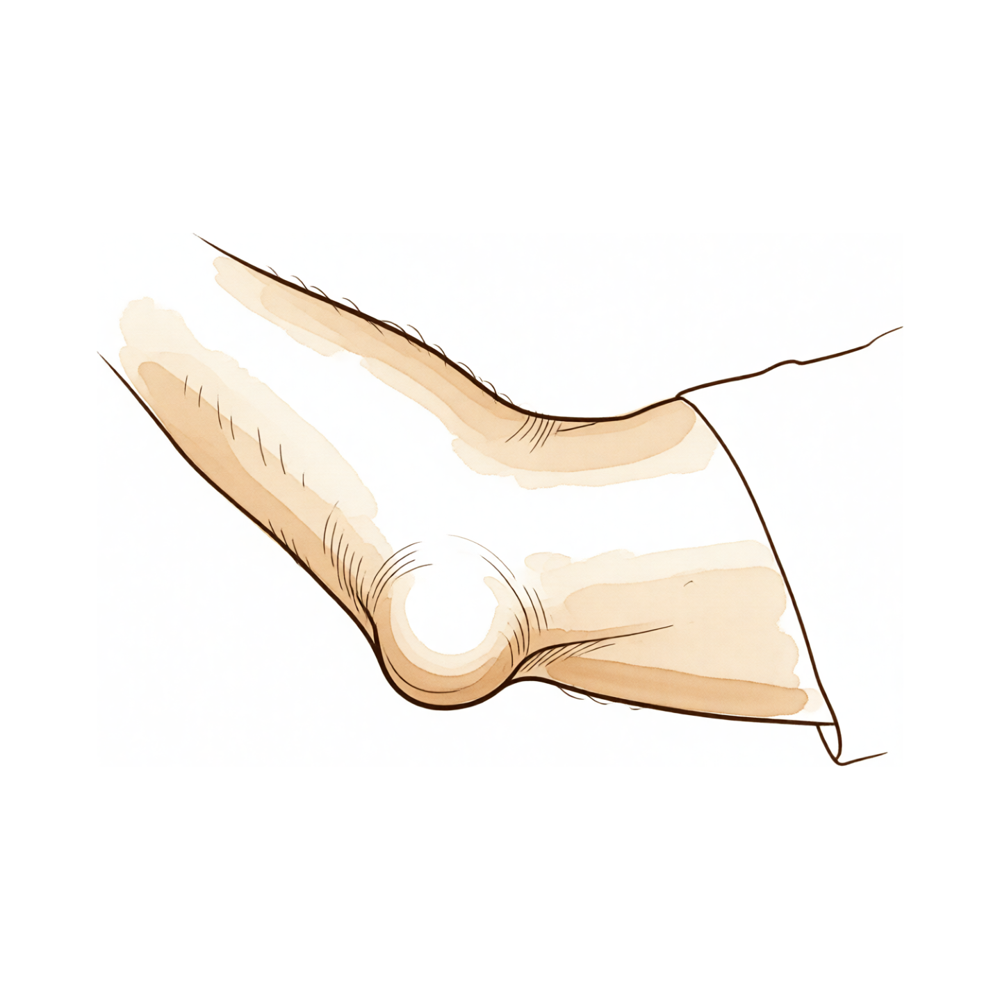
For patients: a plain-language version of this topic is available. See the patient guide.
Overview
Olecranon bursectomy involves the surgical resection of the olecranon bursa, a procedure reserved for chronic or recalcitrant cases where nonsurgical management has failed. Given that nonsurgical management is significantly more effective and safer than surgical intervention [12], surgical resection should not be considered lightly [2]. Indications include chronic traumatic bursitis [11], aseptic olecranon bursitis in patients without rheumatoid arthritis [15], and refractory cases that gain significant physical health benefits from open excision [16]. The procedure is also applicable to septic olecranon bursitis [3] and chronically infected or recurrent conditions, where radical excision combined with radial forearm flap coverage is a reliable and effective option [4]. For patients with recalcitrant bursitis, endoscopic bursectomy serves as a useful treatment option [5] and is not contraindicated in septic cases [3].
The primary goal of the procedure is the complete removal of pathological bursal tissue, which has been curative for all lesions of the olecranon bursa [14]. Properly performed surgical treatment of aseptic olecranon bursitis offers long-lasting symptomatic relief [15]. While open excisional procedures allow for complete tissue removal in unresponsive patients [7], arthroscopy is increasingly considered a suitable modality [7]. Endoscopic techniques, including olecranon extrabursal endoscopic bursectomy, have demonstrated high efficacy; one series reported no recurrences since adopting this technique [9], and patients undergoing endoscopic bursectomy for recalcitrant bursitis experienced no recurrences or wound-healing complications necessitating return to the operating room [10]. Arthroscopic debridement, olecranon spur excision, and loose body removal allow return to throwing sports with reliable subjective and objective results in carefully selected patients [8].
Despite these benefits, the revision rate after bursectomy for olecranon bursitis is 11.5% [1]. Outcomes can be influenced by specific anatomical and pathological factors; for instance, patients with olecranon cords were less satisfied after surgical excision compared to those without cords [21]. Alternative treatments exist for specific subgroups, such as intrabursal doxycycline sclerotherapy for recurrent bursitis refractory to conservative management [13] and hydrothermal ablation at 50C to 52C, which offers comparable efficacy with fewer complications than open bursectomy [24]. Bursal suture repair remains a viable alternative to bursectomy in selected patients with chronic traumatic olecranon bursitis, combining functional and cosmetic benefits [11]. Nontuberculous mycobacterial olecranon bursitis should be considered in any patient with a swollen bursa and protracted course, regardless of immune status [17].
Anatomy & Pathophysiology
Bursal Anatomy & Vulnerability
The olecranon bursa is defined by an abnormal increase in fluid volume within the bursal cavity during bursitis [22]. Its lining consists of a poorly vascularized synovial membrane with a low coefficient of friction, which allows the bony olecranon to glide under the skin during elbow flexion and extension [22]. Due to its superficial position and limited vascularity, the olecranon bursa is particularly vulnerable to injury and inflammation [22]. This limited vascularity is the proposed reason for infection via a transcutaneous route rather than haematogenous spread, even when no obvious wound is present [22]. Among the 150 human bursae, the olecranon is the most commonly affected by an inflammatory process [22].
Microbiology
Staphylococcus aureus predominates as the causative bacteria in olecranon bursitis infections [22]. Beta-haemolytic streptococcus is also a common causative bacteria in these infections [22].
Olecranon Bony Anatomy
The olecranon and the coronoid process form the greater sigmoid notch, which articulates with the trochlea of the distal humerus [30]. The intrinsic anatomy of this greater sigmoid notch articulation allows flexion/extension movement of the elbow joint and provides stability for the elbow [30]. The olecranon serves as the insertion for the triceps tendon, which blends with the periosteum of the proximal ulna [30]. The exposed position of the olecranon renders it vulnerable to direct trauma and violent muscular contractions from the triceps [30].
Pediatric Olecranon Anatomy
In children, the olecranon is predominantly cartilage, particularly in younger children, which reduces the chance of fracture occurring with a direct blow [31]. The thick periosteum and relatively thin metaphyseal cortex of the pediatric olecranon predispose it to minimally displaced greenstick fractures [31].
Classification
Pathophysiology: The olecranon bursa is defined by an abnormal increase in the volume of fluid within the bursal cavity [22]. The bursal lining consists of a poorly vascularized synovial membrane with a low coefficient of friction [22]. This superficial position and limited vascularity render the structure particularly vulnerable to injury and inflammation [22].
Etiology: Limited vascularity is the proposed reason for infection via a transcutaneous route rather than haematogenous spread, even when no obvious wound is present [22]. Staphylococcus aureus predominates as the causative bacteria for olecranon bursitis, with beta-haemolytic strep also being common [22].
Clinical Presentation
Olecranon bursitis is defined by an abnormal increase in the volume of fluid within the bursal cavity [22]. Among the 150 human bursae, the olecranon bursa is the most commonly affected by an inflammatory process [22].
Distinguishing between septic and aseptic olecranon bursitis can be difficult because the physical and laboratory data overlap [25]. Pyoderma gangrenosum must be considered in the differential diagnosis whenever a patient presents with ulcerative cutaneous lesions that resemble an infectious process such as olecranon bursitis [76].
Treatment
Non-Operative
Nonsurgical management of olecranon bursitis is significantly more effective and safer than surgical management [12]. Recent literature demonstrates adverse effects of intrabursal injections and surgery compared with noninvasive management for the initial treatment of nonseptic olecranon bursitis [20].
Operative
Indications: Open excisional procedures allow for the complete removal of pathological bursal tissue in unresponsive patients [7]. Endoscopic olecranon bursal resection should be considered when surgical treatment is necessary for olecranon bursitis [3]. Septic olecranon bursitis is not a contraindication for endoscopic olecranon bursal resection [3].
Surgical Approach / Technique: Arthroscopy is increasingly being considered as a suitable new modality of management for unresponsive patients with olecranon bursitis [7]. Open bursectomy gives satisfactory results for chronic olecranon bursitis [6]. Since adopting the olecranon extrabursal endoscopic bursectomy technique, the authors have had no recurrences of bursitis [9]. Excision has been curative for all lesions of the olecranon bursa in cases of protothecal olecranon bursitis [14].
Other Considerations: Arthroscopic debridement, olecranon spur excision, and loose body removal allow return to throwing sports and reliable subjective and objective results in carefully selected patients with posteromedial elbow impingement [8]. The all-endoscopic technique for refractory elbow bicipitoradial bursitis and partial distal biceps tendon tears is safe and reproducible [18]. The advantages of endoscopic resection of inflamed elbow bicipitoradial bursa and distal biceps tendon synovectomy include small incisions, better cosmetic outcomes, minimal soft-tissue trauma, complete resection of the bicipitoradial bursa, and assessment and treatment of concomitant pathology of the distal biceps tendon [26]. A medial single-window approach to the elbow that does not violate the olecranon bursa ensures sufficient visualization for total elbow arthroplasty while minimizing postoperative complications and allowing early safe mobilization [27]. Thorough bursectomy is performed to expose the footprint of the triceps tendon on the olecranon process after identifying the triceps tear [41]. The bursal tissue over the olecranon footprint is shaved to expose the bone and freshened for improved tendon healing during arthroscopic repair of triceps tendon avulsion [41].
Complications
Wound complications: In patients undergoing endoscopic olecranon bursectomy for recalcitrant olecranon bursitis, no recurrences or wound-healing complications necessitating return to the operating room were observed [10].
Infection (PJI): The limited vascularity of the olecranon bursa is the proposed reason for infection via a transcutaneous route, rather than via haematogenous spread, even when no obvious wound is present [22].
Other Considerations: Hydrothermal ablation at temperatures between 50C and 52C is a safe treatment option for recurrent or chronic olecranon bursitis with fewer complications than open bursectomy [24].
Recovery
Other Considerations: Endoscopic olecranon bursal resection is considered when surgical treatment is necessary, and septic olecranon bursitis is not a contraindication for this procedure [3]. In unresponsive patients, open excisional procedures allow complete removal of the pathological bursal tissue, while arthroscopy is increasingly considered as a suitable new modality of management [7].
Key Evidence
- [L3] The revision rate after bursectomy for olecranon bursitis was 11.5%. [1] (10.1016/j.jse.2020.09.033)
- [L4] We believe that endoscopic olecranon bursal resection should be considered when it is necessary to perform surgical treatment for olecranon bursitis and septic olecranon bursitis is not a contraindication for endoscopic olecranon bursal resection. [3] (10.1142/s2424835516500156)
- [L4] Radical excision of chronically infected or recurrent olecranon bursitis and radial forearm flap coverage is a simple, reliable, and extremely effective procedure. [4] (10.1097/00130911-200106000-00007)
- [L5] Endoscopic bursectomies are a useful treatment option for patients with recalcitrant olecranon bursitis. [5] (10.1016/j.eats.2023.09.004)
- [L4] The operation appears to give satisfactory results for chronic olecranon bursitis. [6] (10.1016/s0020-1383(77)80050-8)
- [L4] In unresponsive patients, although open excisional procedures allow to completely remove the pathological bursal tissue, arthroscopy is increasingly being considered as a suitable new modality of management. [7] (10.1016/j.surge.2012.02.002)
- [L4] Arthroscopic debridement, olecranon spur excision, and loose body removal allow return to throwing sports and reliable subjective and objective results in carefully selected patients. [8] (10.1016/j.arthro.2011.06.012)
- [L4] Since changing to this technique, the authors have had no recurrences of bursitis. [9] (10.1097/bth.0b013e31829c0535)
- [L4] In this population, patients who underwent endoscopic olecranon bursectomy experienced no recurrences or wound-healing complications necessitating return to the operating room. [10] (10.1016/j.asmr.2023.100832)
- [L5] Bursal suture repair is a viable alternative to bursectomy in selected patients with chronic traumatic olecranon bursitis, combining functional and cosmetic benefits. [11] (10.1016/j.xrrt.2025.100597)
- [L4] Based primarily on level IV evidence, nonsurgical management of olecranon bursitis is significantly more effective and safer than surgical management. [12] (10.1007/s00402-014-2088-3)
- [L4] This may be an effective alternative to surgical bursectomy for patients with recurrent olecranon bursitis refractory to conservative management. [13] (10.1016/j.jhsg.2024.03.006)
- [Case_report] Excision has been curative for all lesions of the olecranon bursa, whereas multiple medications have been tried for cutaneous and systemic infections without clear-cut success. [14] (10.2106/00004623-198062050-00024)
- [L4] Properly performed surgical treatment of aseptic olecranon bursitis appears to offer long-lasting symptomatic relief to patients without rheumatoid arthritis. [15] (10.1016/s1058-2746(97)90070-7)
- [L4] Patients with refractory olecranon bursitis, particularly if aseptic, tend to gain significant physical health benefits from open bursectomy. [16] (10.7759/cureus.43696)
- [L4] Nontuberculous mycobacterial olecranon bursitis should be considered in any patient with a swollen bursa and protracted course, regardless of immune status. [17] (10.1016/j.jse.2008.07.009)
- [L5] The all-endoscopic technique is safe and reproducible, and it is a stepping-stone in the learning curve of all-endoscopic repair and reconstruction of distal biceps ruptures. [18] (10.1016/j.eats.2022.02.017)
- [L4] Arthroscopic bursectomy resulted in significant improvements in shoulder function and pain, but outcomes were significantly worse in patients with a longer duration of preoperative complaints and those with peroperative identification of degenerative glenoid cartilage. [19] (10.1016/j.jseint.2020.10.021)
- [L5] Older studies showed resolution with injections and surgery, but more recent literature demonstrates adverse effects of intrabursal injections and surgery compared with noninvasive management for initial treatment of nonseptic olecranon bursitis. [20] (10.1016/j.jhsa.2021.02.006)
- [L4] Patients with olecranon cords were less satisfied after surgical excision compared to those without cords. [21] (10.1016/j.jse.2015.04.016)
- [L4] [22] (10.1177/1758573214532787)
- [L4] Hydrothermal ablation at temperatures between 50C and 52C is a safe treatment option for recurrent or chronic olecranon bursitis with fewer complications than open bursectomy and a comparable efficacy. [24] (10.1016/j.jse.2024.03.021)
- [L5] Distinguishing between septic and aseptic olecranon bursitis can be difficult because the physical and laboratory data overlap. [25] (10.1016/j.jse.2015.08.032)
- [L5] The advantages of the described technique include small incisions and better cosmetic outcomes, minimal soft-tissue trauma, complete resection of the bicipitoradial bursa, and assessment and treatment of concomitant pathology of the distal biceps tendon. [26] (10.1016/j.eats.2025.103501)
- [L4] This approach ensures sufficient visualization for total elbow arthroplasty while minimizing postoperative complications and allowing early safe mobilization. [27] (10.1016/j.xrrt.2025.08.016)
- [L5] [41] (10.1016/j.eats.2024.103129)
- [Case_report] PG must be considered in the differential diagnosis whenever a patient presents with ulcerative cutaneous lesions that resemble an infectious process such as olecranon bursitis. [76] (10.1016/j.jse.2014.06.032)
See Also
References
[1] Factors associated with revision surgery for olecranon bursitis after bursectomy. Journal of Shoulder and Elbow Surgery. 2021. DOI: 10.1016/j.jse.2020.09.033
[2] Complications following resection of the olecranon bursa. Acta Orthopaedica Belgica. 2006.
[3] Endoscopic Olecranon Bursal Resection for Olecranon Bursitis: A Comparative Study for Septic and Aseptic Olecranon Bursitis. The Journal of Hand Surgery (Asian-Pacific Volume). 2016. DOI: 10.1142/s2424835516500156
[4] Treatment of Chronic Infected Olecranon Bursitis by Radical Excision and Radial Forearm Flap Coverage. Techniques in Hand & Upper Extremity Surgery. 2001. DOI: 10.1097/00130911-200106000-00007
[5] Endoscopic Olecranon Bursectomy in the Treatment of Recalcitrant Olecranon Bursitis: Patient Selection and Operative Technique. Arthroscopy Techniques. 2023. DOI: 10.1016/j.eats.2023.09.004
[6] A useful procedure in the treatment of chronic olecranon bursitis. Injury. 1977. DOI: 10.1016/s0020-1383(77)80050-8
[7] Diagnosis and management of olecranon bursitis. The Surgeon. 2012. DOI: 10.1016/j.surge.2012.02.002
[8] Posteromedial Elbow Impingement: Magnetic Resonance Imaging Findings in Overhead Throwing Athletes and Results of Arthroscopic Treatment. Arthroscopy. 2011. DOI: 10.1016/j.arthro.2011.06.012
[9] Olecranon Extrabursal Endoscopic Bursectomy. Techniques in Hand & Upper Extremity Surgery. 2013. DOI: 10.1097/bth.0b013e31829c0535
[10] No Wound Healing Complications or Recurrences Were Seen and a High Level of Satisfaction Was Reported in Patients Who Underwent Endoscopic Olecranon Bursectomy for Recalcitrant Olecranon Bursitis. Arthroscopy, Sports Medicine, and Rehabilitation. 2024. DOI: 10.1016/j.asmr.2023.100832
[11] Olecranon bursal repair for chronic traumatic bursitis: a surgical technique. JSES Reviews, Reports, and Techniques. 2026. DOI: 10.1016/j.xrrt.2025.100597
[12] Treatment of olecranon bursitis: a systematic review. Archives of Orthopaedic and Trauma Surgery. 2014. DOI: 10.1007/s00402-014-2088-3
[13] Intrabursal Doxycycline Sclerotherapy for Recurrent Olecranon Bursitis of the Elbow: A Case Control Study. Journal of Hand Surgery Global Online. 2024. DOI: 10.1016/j.jhsg.2024.03.006
[14] Protothecal olecranon bursitis. A case report and review of the literature.. The Journal of Bone & Joint Surgery. 1980. DOI: 10.2106/00004623-198062050-00024
[15] Surgical treatment of aseptic olecranon bursitis. Journal of Shoulder and Elbow Surgery. 1997. DOI: 10.1016/s1058-2746(97)90070-7
[16] Clinical Outcomes Following Open Olecranon Bursa Excision for Septic and Aseptic Olecranon Bursitis: An Observational Study. Cureus. 2023. DOI: 10.7759/cureus.43696
[17] Nontuberculous mycobacterial olecranon bursitis: Case reports and literature review. Journal of Shoulder and Elbow Surgery. 2009. DOI: 10.1016/j.jse.2008.07.009
[18] “All‐Endoscopic” Management of Refractory Elbow Bicipitoradial Bursitis and Partial Distal Biceps Tendon Tears. Arthroscopy Techniques. 2022. DOI: 10.1016/j.eats.2022.02.017
[19] Arthroscopic bursectomy less effective in the degenerative shoulder with chronic subacromial pain. JSES International. 2021. DOI: 10.1016/j.jseint.2020.10.021
[20] Clinical Management of Olecranon Bursitis: A Review. The Journal of Hand Surgery. 2021. DOI: 10.1016/j.jhsa.2021.02.006
[21] The existence of cords in olecranon bursae. Journal of Shoulder and Elbow Surgery. 2015. DOI: 10.1016/j.jse.2015.04.016
[22] Olecranon bursitis: a systematic overview. Shoulder & Elbow. 2014. DOI: 10.1177/1758573214532787
[24] Hydrothermal ablation in recurrent or chronic olecranon bursitis: a prospective study. Journal of Shoulder and Elbow Surgery. 2024. DOI: 10.1016/j.jse.2024.03.021
[25] Olecranon bursitis. Journal of Shoulder and Elbow Surgery. 2016. DOI: 10.1016/j.jse.2015.08.032
[26] Endoscopic Resection of Inflamed Elbow Bicipitoradial Bursa and Distal Biceps Tendon Synovectomy. Arthroscopy Techniques. 2025. DOI: 10.1016/j.eats.2025.103501
[27] Medial single-window approach to the elbow: a triceps-on technique that does not violate the olecranon bursa. JSES Reviews, Reports, and Techniques. 2026. DOI: 10.1016/j.xrrt.2025.08.016
[30] Aaos Comprehensive Orthopaedic Review 3. Fractures of the Elbow > II. Olecranon Fractures.
[31] Tachdjian S Pediatric Orthopaedics From The Texas Scottish Rite Hospital For Children E Book. Pigmented Villonodular Synovitis and Giant Cell Tumor of the Tendon Sheath > Olecranon Fractures.
[41] Arthroscopic Repair of the Triceps Tendon Avulsion—Double‐Row Repair. Arthroscopy Techniques. 2024. DOI: 10.1016/j.eats.2024.103129
[76] Case report: misdiagnosed olecranon bursitis: pyoderma gangrenosum. Journal of Shoulder and Elbow Surgery. 2014. DOI: 10.1016/j.jse.2014.06.032