Clinicians › Elbow
Distal Triceps Tendon Rupture
Distal triceps avulsion: risk factors, flake sign and MRI grading of partial vs complete, non-operative partial tears vs early transosseous/suture-anchor repair, outcomes and pitfalls.
For patients: a plain-language version of this topic is available. See the patient guide.
Overview
Distal triceps tendon rupture is a rare injury that traditionally affects an active population, with repairs occurring most frequently in men aged 40 to 59 years [2, 3, 20]. Complete distal triceps tendon tears are optimally treated with surgical repair, particularly when performed acutely [3]. Surgical repair is strongly recommended for complete ruptures to provide active extension at the elbow [4, 28]. Operative management is required in most cases, especially for active patients, laborers, and athletes wishing to return to competition [23]. Most complete triceps tendon injuries should be managed with surgical repair, which offers a predictable return of function with a small risk of loss of elbow motion [25]. In contrast, acute partial triceps tendon ruptures may have good outcomes with nonoperative management [4, 28].
Early surgical repair within three weeks after injury is the treatment of choice for distal triceps tendon ruptures [7]. Primary repair of acute and chronic distal triceps tendon ruptures in a general population yields satisfactory results in the majority of patients with a low rerupture rate [16]. Distal triceps tendon repair reliably restores elbow function and provides good patient outcomes with a low complication rate [1]. Surgical repair of distal triceps tendon ruptures can be accomplished with predictable results [9]. Early surgical repair for traumatic distal triceps tendon ruptures yielded good results [10]. Triceps tendon ruptures may result in uniformly good to excellent results if recognized and treated surgically [6]. Primary repair of distal triceps tendon ruptures yields good, durable patient outcomes with minimal rerupture regardless of repair construct [17]. Surgical repair of acute triceps tendon ruptures reliably restores strength and function even in high-demand individuals [30]. Patients undergoing distal triceps tendon rupture repair experience improvements in postoperative outcomes [13].
There is a moderate reported risk of rerupture or complication following distal triceps tendon rupture repair [13]. Distal triceps repair for traumatic injuries is associated with a 14% complication rate [18]. Distal triceps repair for traumatic injuries is associated with a 13.1% reoperation rate [18]. Distal triceps tendon repair surgery has a relatively high complication and reoperation rate regardless of repair technique [37]. Partial ruptures of the distal triceps tendon typically occur in the superficial, lateral portion of the tendon [8]. Partial ruptures of the distal triceps tendon demonstrate a not statistically significant lower ultimate load to failure than intact tendons [8].
Anatomy & Pathophysiology
Bony Anatomy
The elbow functions as a trocho-ginglymoid joint comprising medial and lateral articulations that provide inherent bony stability [56]. The ulnohumeral joint is formed by the articulation of the trochlea with the ulna within the greater sigmoid notch, while the radiocapitellar joint involves the articulation of the capitellum with the radial head [56]. The olecranon serves as a broad posterior attachment site for the triceps tendon [56]. In the sagittal plane, the proximal ulna exhibits a slight anterior bow, with the articulation to the tip of the coronoid positioned approximately 30° from the long axis of the ulna [56]. Correspondingly, the distal humeral articular surface is angled 30° anterior to the humeral shaft axis [56, 62]. In the coronal plane, the medial column of the distal humerus diverges from the humeral shaft at a 45-degree angle, whereas the lateral column diverges at a 20-degree angle [64]. The trochlea is covered by articular cartilage forming an arc of almost 270 degrees, and the olecranon fossa is anatomically matched to accept the olecranon during extension [67].
Soft Tissue Anatomy
The triceps acts as the primary elbow extensor, inserting on the olecranon process via a broad tendinous attachment [57, 64]. This insertion comprises three distinct areas corresponding to the posterior capsular insertion, the deep muscular portion, and the superficial tendinous portion [55]. The deep muscular head corresponds to the medial head, while the tendinous portion corresponds to the long and lateral heads [55]. At insertion, the triceps tendon measures 2.6 cm in width and is located 1.1 cm from the tip of the olecranon [55]. MRI imaging describes a bipartite insertion into the olecranon between superficial and deep components [22]. A defined interval known as the "triceps decussation" exists between the lateral triceps expansion and the medial triceps tendon just proximal to the olecranon [22]. The muscle fibers of the lateral head blend imperceptibly with those of the anconeus muscle, and the tendinous portion of the lateral triceps on the olecranon is slanted laterally with strong fascial connections extending over the anconeus [127]. The anconeus muscle functions as a secondary stabilizer of the elbow [41].
Epidemiology & Risk Factors
Triceps tendon injuries are possibly the rarest of all tendon injuries, with a male predominance of 2:1 [27]. Specific populations and conditions predispose individuals to rupture, including adolescents with incompletely fused or recently fused physes [27]. Contributing etiologies include renal osteodystrophy, metabolic bone diseases, and anabolic steroid use [27].
Mechanism of Injury
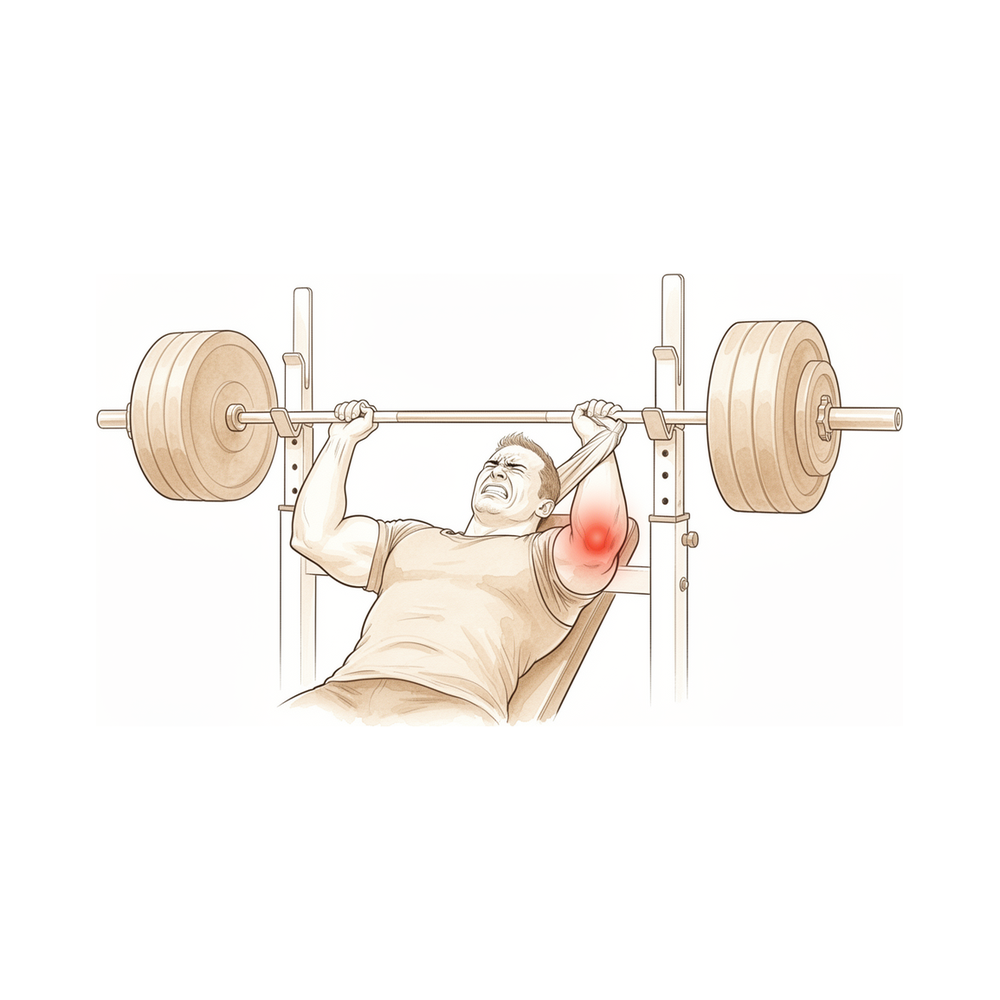
The usual mechanism of injury is a forceful sudden flexion of an extended elbow [22]. The most common mechanism involves a sudden eccentric load applied to a contracting triceps muscle, such as during weight lifting or from a fall onto an outstretched hand [49]. Specifically, the typical traumatic event is a fall on an outstretched hand where a deceleration load is applied to the triceps while it is actively contracting [27]. Direct trauma, motor vehicle accidents, and power lifting can also cause distal triceps rupture [27]. Lacerations and open injuries, with or without elbow fracture-dislocation, represent additional mechanisms of injury [22]. Higher-energy mechanisms such as motor vehicle accidents or falls from a height may cause concomitant ulnar nerve injury and compartment syndrome [49].
Pathology & Rupture Patterns
Triceps tendon ruptures are usually seen at the osseous insertion, though ruptures within the muscle belly and tears at the myotendinous junction have been reported [49]. Fatigue failure of the muscle has been suggested as a mechanism for intramuscular tears [49]. In fall on an outstretched hand injuries, the lateral and long heads of the triceps brachii play primary roles in eccentric contraction, resulting in only superficial tendon tears [33]. In direct injury mechanisms, full-thickness tendon tears are more common than in indirect mechanisms [33]. Most traumatic distal triceps tendon ruptures developing by indirect mechanisms are partial tears [33]. The majority of triceps injuries are partial because the lateral aspect of the triceps usually remains in continuity with the anconeus muscle [127]. Partial triceps rupture alone can be well tolerated for daily activities [127]. Triceps tendon ruptures are frequently associated with a radial head fracture or medial collateral ligament rupture [127]. Because of a partially intact triceps combined with the anconeus muscle, the force vector of the whole elbow extensor is displaced laterally and acts as a valgus stress [127]. Abnormal repetitive valgus torques from this lateral displacement of the extensor force vector cause increased stress on medial structures [127].
Classification
Epidemiology and Demographics
Distal triceps injuries are uncommon, with a male predominance of 2:1 [21] [27]. The injury has been described through a gamut of ages [27]. Adolescents who have incompletely fused or recently fused physes are susceptible to triceps tendon rupture [27]. Triceps tendon tears requiring repair are more prevalent in professional football players than previously reported and are more common than in the general population [31].
Mechanism of Injury
The mechanism of injury is typically an acute trauma in which the tendon avulses off the olecranon [27]. Most commonly, the traumatic event is a fall on an outstretched hand in which a deceleration load is applied to the triceps while it is actively contracting [27]. Other mechanisms include direct trauma, motor vehicle accidents, and power lifting [27]. Laceration and open injuries with or without elbow fracture-dislocation can also cause distal triceps rupture [22]. Spontaneous ruptures and ruptures at the musculotendinous junction and muscle belly have also been described, but are less frequent [27]. Renal osteodystrophy, metabolic bone diseases, and anabolic steroid use are contributing etiologies that have also been reported [27]. Triceps tendon ruptures may result from steroid injections [6]. The main causes of tendon lesions can be explained by acute traumatic events or pathological chronic tendinitis in patients with cumulative submaximal loading or as iatrogenic condition with history of surgery that violated the extensor mechanism [22].
Anatomical Location and Pattern
There have been reports of rupture within the muscle belly and tears at the myotendinous junction [49]. In fall on an outstretched hand injuries, all patients had superficial distal triceps tendon tears [33]. In direct injury groups, three of seven elbows had full-thickness tendon tears [33]. The lateral and long heads of the triceps brachii have primary roles in eccentric contraction in fall on an outstretched hand injuries, resulting in only superficial tendon tears [33]. Most traumatic distal triceps tendon ruptures that developed by indirect mechanisms were partial tears [33]. Tear of the triceps at the musculotendinous junction is a rare injury [34]. The medial head of the triceps has a tendon that is distinct from, and deep to, the common tendon of the long and lateral heads on gross inspection [48]. Histologic studies show the insertion of the medial head tendon and the common tendon of the long and lateral heads is confluent [48]. The distinct insertional heads of the triceps provide additional knowledge that can aid in diagnosing and treating partial triceps tears [32].
Clinical Presentation and Diagnosis
Patients present with pain and swelling over the posterior aspect of the elbow [49]. Physical examination reveals tenderness to palpation, swelling, and ecchymosis [49]. A palpable defect proximal to the olecranon can also be apparent and may confirm the clinical diagnosis [49]. In the acute stage, a defect may not be palpable secondary to swelling, body habitus, or the degree of rupture [49]. The inability to actively extend against resistance is a sign of complete rupture [49]. Not all complete tears result in the inability to actively extend against resistance [49]. The inability to actively extend against resistance in complete tears is likely secondary to an intact lateral expansion or a compensating anconeus muscle [49]. Almost 50% of acute triceps ruptures were initially misdiagnosed [49]. In the setting of chronic tears, the most common complaints are of pain and weakness [49].
Clinical Presentation
Epidemiology and Risk Factors
Distal triceps tendon injuries are relatively rare, estimated to account for less than 1% of all upper limb tendon injuries [44]. These injuries can occur through healthy tissue [24]. Studied risk factors include steroid use, endocrine disorders, renal failure, and metabolic bone diseases [101]. Knowledge of risk factors and mechanism of injury, along with a thorough history and physical examination, helps avoid unnecessary delay in diagnosis or treatment [11].
Mechanism and Injury Pattern
In fall-on-outstretched-hand injuries, the lateral and long heads of the triceps brachii have primary roles in eccentric contracture, resulting in only superficial tendon tears [33].
Clinical Findings and Diagnosis
Diagnosis of a triceps rupture of the distal insertion can be readily made on physical examination, where pain, swelling, and a palpable defect can often be identified just proximal to the olecranon posteriorly [101]. However, these injuries can be difficult to diagnose and are frequently missed in the emergency department [44]. Avulsion of the triceps tendon is easily overlooked in the acute stage, especially when combined with other lesions in the region such as fracture of the head or neck of the radius [51].
Imaging
MRI can help confirm the diagnosis and is helpful in preoperative planning [11]. Magnetic resonance imaging with the elbow flexed can help differentiate snapping of the triceps from other etiologies affecting the lateral elbow [35].
Investigations
Clinical Assessment
A thorough history and physical examination are essential to avoid unnecessary delay in the diagnosis or treatment of triceps tendon rupture [11]. The usual mechanism of injury is a forceful, sudden flexion of the extended elbow [22]. Laceration and open injuries, with or without elbow fracture-dislocation, can also cause distal triceps rupture [22]. Triceps tendon avulsion is easily overlooked in the acute stage, especially when combined with other lesions in the region such as fracture of the head or neck of the radius [51]. The finding of clinically detectable medial triceps dislocation in an asymptomatic individual raises the question of its true incidence in the general population [46].
Imaging
Plain radiography: Most triceps tendon ruptures are accompanied by avulsion fracture of the olecranon. It is important to suspect this injury when radiographs show a small fleck of bone avulsed from the olecranon [129].
MRI: MRI can help confirm the diagnosis of distal triceps tendon injury and is helpful in preoperative planning [11]. MRI describes a bipartite insertion between the superficial and deep components of the triceps tendon into the olecranon [22].
Treatment
Non-Operative Management
Conservative management is appropriate for patients with partial triceps tendon ruptures who have low physical demands, provided pain is eliminated and function is satisfactory for the individual [98]. Partial ruptures can heal without functional deficit [19], and cases with lower functional expectations may be treated successfully with a conservative approach [95]. In one instance, conservative management was entirely appropriate for a patient with bilateral partial triceps tendon rupture, resulting in an excellent functional outcome [15].
Operative Management
Indications and Timing: Surgical repair is strongly recommended for complete ruptures [4], particularly when performed acutely [3]. Early surgical repair, within three weeks after the injury, is the treatment of choice for distal triceps tendon ruptures [7]. Surgery should be preferred in patients with higher functional necessities [95]. For young, healthy, high-demand patients with partial ruptures, operative repair using bone tunnels leads to a return to full function and should be utilized over conservative management [53]. While delayed repair is technically demanding and results are inferior to acute repair [44], the time of delay from injury to repair seems to have little effect on the functional outcome [24]. Delayed repairs are more technically difficult for the surgeon to perform but also have reasonable outcomes [98].
Techniques and Constructs: Distal triceps tendon repair reliably restores elbow function, provides good patient outcomes, and has a low complication rate [1]. The primary goals of surgical treatment are to achieve strong and reliable reattachment of the tendon, with or without bony avulsion, to the proximal ulna to restore function [43]. Achieving a solid repair with or without augmentation, and setting the right tension, are of extreme importance when surgical treatment is pursued [11]. Suture anchor repair of distal triceps tendon ruptures showed excellent elbow function based on validated clinical outcome measures [38]. Early surgical repair for traumatic distal triceps tendon ruptures yielded good results, with the anchor group showing statistically significant earlier release from medical care [10]. Arthroscopic triceps tendon repair is safe and effective, with excellent pain relief, excellent functional scores, minimal complications, and the ability to address concomitant elbow pathologies [114]. Endoscopic repair of partial distal triceps tendon tears leads to good clinical and radiological results after 12 months, with patients benefiting especially from an improvement of extension strength [14]. Endoscopic repair of superficial tears of the triceps tendon is able to restore function and strength and leads to excellent clinical results after 1 year [29].
Chronic Tears: Chronic tears of the distal triceps tendon are uncommon lesions, with a significantly lower incidence compared with other local disorders such as epicondylitis or distal biceps ruptures [95]. The surgical approach to chronic tears is often more complex in comparison to that of acute tears [95]. The triceps often retracts within a few weeks, making a direct reattachment difficult or even impossible in chronic tears [95]. Primary repair of chronic tears is hindered by the quality of the tendon remnants, which often results to be poor, especially in patients with previous surgeries [95].
Outcomes and Complications: Despite the heightened risk of perioperative complications after primary repair of distal triceps tendon injuries, current series identify favorable functional outcomes and no cases of re-rupture at short- to mid-term follow-up [5]. Similarly, despite the heightened risk of perioperative complications, current series found favorable functional outcomes and no cases of reruptures at short-term to midterm follow-up [12]. Patients undergoing distal triceps tendon rupture repair experience improvements in postoperative outcomes; however, there is a moderate reported risk of rerupture or complication [13]. Distal triceps repair for traumatic injuries is associated with 14% complication and 13.1% reoperation rates [18]. Regardless of repair technique, distal triceps tendon repair surgery has a relatively high complication and reoperation rate [37].
Rehabilitation
At 2 weeks, the wound is reviewed, and the patient is put into a hinged elbow brace, allowing 20° to 120° of assisted passive movement [43]. Following the initial 2 weeks, a further 2 weeks of unrestricted assisted passive movement in the brace is performed [43]. Active range of motion and physiotherapy begin at 4 weeks to optimize range of movement and begin strengthening exercises [43]. In the first month post-surgery, an orthopedic cast is used [95]. In the second month post-surgery, a hinged brace permitting 0-60 degrees of range of motion is used, and extension against resistance and weightlifting are not allowed [95]. In the third month post-surgery, a hinged brace permitting 0-90 degrees of range of motion is used, and extension against resistance is allowed while weightlifting is not allowed [95].
Complications
General Risk: Primary repair of distal triceps tendon injuries carries a heightened risk of perioperative complications [5]. The procedure is associated with a relatively high complication rate [37] and a relatively high reoperation rate [37]. Patients undergoing repair experience a moderate reported risk of rerupture or complication [13].
Stiffness / Arthrofibrosis: Surgical repair of distal triceps tendon injuries offers a small risk of loss of elbow motion [25].
Recovery
Functional Outcomes: Early surgical management with repair of the tendon to bone provides a satisfactory outcome in most patients [133]. Despite a heightened risk of perioperative complications following primary repair of distal triceps tendon injuries, favorable functional outcomes and no cases of re-rupture were identified at short- to mid-term follow-up [5]. Similarly, favorable functional outcomes and no cases of reruptures were found at short-term to midterm follow-up [12].
Return to Work: 93.2% of patients returned to work at an average of 2.2±3.2 months following distal triceps repair [39]. 89.2% of patients were able to return to the same level of occupational intensity according to the US Department of Labor classification system [39]. Patients in higher-intensity occupations had a lower rate of return to work and took longer to return to work than patients in lower-intensity occupations [39].
Occupational Intensity Specifics: Patients holding sedentary-intensity occupations returned to their previous level of occupational intensity at a rate of 100.0% at a duration of 0.3±0.5 months [39]. Patients holding light-intensity occupations returned to their previous level of occupational intensity at a rate of 100.0% at a duration of 1.8±1.5 months [39]. Patients holding moderate-intensity occupations returned to their previous level of occupational intensity at a rate of 80.0% at a duration of 2.5±3.6 months [39]. Patients holding heavy-intensity occupations returned to their previous level of occupational intensity at a rate of 76.9% at a duration of 4.8±3.9 months [39].
Workers’ Compensation: 75% of patients covered by workers’ compensation were able to return to their previous occupation by 6.5±4.3 months postoperatively [39]. 100% of patients with non–workers’ compensation designation returned to work by 1.1±1.6 months [39].
Timing and Delay: The time of delay from injury to repair seems to have little effect on the functional outcome for triceps tendon ruptures [24].
Key Evidence
- [L4] Distal triceps tendon repair reliably restores elbow function, provides good patient outcomes and has a low complication rate. [1] (10.1016/j.jse.2016.12.062)
- [L4] A distal triceps tendon rupture is a rare but potentially challenging injury, traditionally occurring in an active population, and often requires surgical repair. [2] (10.1177/03635465241283970)
- [Paper] Distal triceps tendon injuries are relatively rare, with complete tears optimally treated with surgical repair, particularly when performed acutely. [3] (10.1016/j.csm.2020.03.003)
- [L4] Acute partial triceps tendon ruptures may have good outcomes with nonoperative management, whereas surgical repair is strongly recommended for complete ruptures. [4] (10.2106/jbjs.rvw.19.00172)
- [L4] Despite heightened risk of perioperative complications after primary repair of distal triceps tendon injuries, the current series identifies favorable functional outcomes and no cases of re-rupture at short- to mid-term follow-up. [5] (10.1177/2325967118s00163)
- [L4] Triceps tendon ruptures may result in uniformly good to excellent results if recognized and treated surgically. [6] (10.1177/036354659302100327)
- [L4] Early surgical repair, within three weeks after the injury, is the treatment of choice for distal triceps tendon ruptures. [7] (10.2106/00004623-200310000-00015)
- [L5] Partial ruptures of the distal triceps tendon demonstrate a not statistically significant lower ultimate load to failure than intact tendons and typically occur in the superficial, lateral portion of the tendon. [8] (10.1186/s12891-023-06720-3)
- [Case_report] Surgical repair of distal triceps tendon ruptures can be accomplished with predictable results. [9] (10.1016/j.jse.2006.06.002)
- [Abstract] Early surgical repair for traumatic distal triceps tendon ruptures yielded good results, with the anchor group showing statistically significant earlier release from medical care. [10] (10.1016/j.jse.2014.11.027)
- [L5] [11] (10.1097/bth.0000000000000082)
- [L4] Despite the heightened risk of perioperative complications after primary repair of distal triceps tendon injuries, the current series found favorable functional outcomes and no cases of reruptures at short-term to midterm follow-up. [12] (10.1177/2325967119839998)
- [L4] Patients undergoing distal triceps tendon rupture repair experience improvements in postoperative outcomes; however, there is a moderate reported risk of rerupture or complication. [13] (10.1016/j.jse.2021.06.019)
- [L4] Endoscopic repair of partial distal triceps tendon tears leads to good clinical and radiological results after 12 months, with patients benefiting especially from an improvement of extension strength. [14] (10.1016/j.arthro.2013.03.049)
- [L4] Conservative management was entirely appropriate for this patient with bilateral partial triceps tendon rupture, resulting in excellent functional outcome. [15] (10.1177/0363546503258903)
- [L4] Primary repair of acute and chronic distal triceps tendon ruptures in a general population yields satisfactory results in the majority of patients with a low rerupture rate. [16] (10.1302/0301-620x.100b5.bjj-2017-1057.r2)
- [L3] Primary repair of distal triceps tendon ruptures yields good, durable patient outcomes with minimal rerupture regardless of repair construct. [17] (10.1016/j.jse.2017.08.006)
- [L3] Distal triceps repair for traumatic injuries is associated with 14% complication and 13.1% reoperation rates. [18] (10.1016/j.xrrt.2022.05.004)
- [L4] Partial triceps tendon ruptures can heal without functional deficit. [19] (10.1177/0095399703258707)
- [L3] Distal triceps repairs in this large cohort study occur most frequently in men aged 40 to 59 years. [20] (10.1177/15589447221095114)
- [L4] Distal triceps injuries are uncommon. [21] (10.5312/wjo.v8.i6.507)
- [L5] [22] (10.1007/s12306-015-0359-y)
- [L5] Operative management of complete distal biceps and triceps tendon ruptures is required in most cases, especially for active patients, laborers, and athletes wishing to return to competition. [23] (10.1016/j.hcl.2016.08.019)
- [L4] Triceps tendon ruptures can occur through healthy tissue, and the time of delay from injury to repair seems to have little effect on the functional outcome. [24] (10.1177/036354658401200415)
- [L5] Most complete triceps tendon injuries should be managed with surgical repair, which offers a predictable return of function with a small risk of loss of elbow motion. [25] (10.1016/j.hcl.2015.06.010)
- [L5] [27] (10.1016/j.csm.2004.06.001)
- [L5] Complete triceps tendon ruptures must be repaired to provide active extension at the elbow, while partial tears may be treated conservatively. [28] (10.1016/j.jhsa.2015.05.016)
- [L4] Endoscopic repair of superficial tears of the triceps tendon is able to restore function and strength and leads to excellent clinical results after 1 year. [29] (10.1016/j.arthro.2014.03.005)
- [L3] Surgical repair of acute triceps tendon ruptures reliably restores strength and function even in high-demand individuals. [30] (10.1016/j.injury.2016.07.061)
- [L4] Triceps tendon tears requiring repair are more prevalent in professional football players than previously reported and are more common than in the general population. [31] (10.1177/2325967115601021)
- [L5] The distinct insertional heads of the triceps provide additional knowledge that can aid in diagnosing and treating partial triceps tears. [32] (10.1016/j.jses.2017.05.002)
- [L3] [33] (10.1097/corr.0000000000001550)
- [L5] Tear of the triceps at the musculotendinous junction is a rare injury. [34] (10.1016/s0363-5023(97)80175-x)
- [L5] Magnetic resonance imaging with the elbow flexed can help differentiate snapping of the triceps from other etiologies affecting the lateral elbow. [35] (10.1053/jhsu.1999.0381)
- [L4] Regardless of repair technique, distal triceps tendon repair surgery has a relatively high complication and reoperation rate. [37] (10.1016/j.xrrt.2024.06.008)
- [L4] This retrospective case series of suture anchor repair of distal triceps tendon ruptures showed excellent elbow function based on validated clinical outcome measures. [38] (10.1016/j.arthro.2011.12.016)
- [L4] [39] (10.1016/j.jse.2020.07.036)
- [Paper] [43] (10.1016/j.eats.2018.09.006)
- [L4] [44] (10.1177/1758573217706358)
- [L4] The finding of clinically detectable medial triceps dislocation in an asymptomatic individual raises the question of its true incidence in the general population. [46] (10.1016/s0363-5023(05)80193-5)
- [L4] The medial head of the triceps has a tendon that is distinct from, and deep to, the common tendon of the long and lateral heads on gross inspection, though histologic studies show the insertion of these 2 tendons is confluent. [48] (10.1177/0363546506288752)
- [L5] [49] (10.5435/00124635-201001000-00005)
- [L5] Avulsion of the triceps tendon is easily overlooked in the acute stage, especially when combined with other lesions in the region such as fracture of the head or neck of the radius. [51] (10.1016/0020-1383(86)90238-x)
- [L5] The authors conclude that operative repair of partial tricep tendon ruptures using bone tunnels in a young, healthy, high-demand patient leads to return to full function and should be utilized over conservative management. [53] (10.1093/milmed/usx075)
- [L5] [95] (10.1097/bte.0000000000000197)
- [L5] [98] (10.1197/j.jht.2006.02.001)
- [L4] [101] (10.1055/s-0038-1636729)
- [L4] In this study, we found that arthroscopic triceps tendon repair is safe and effective, with excellent pain relief, excellent functional scores, minimal complications, and the ability to address concomitant elbow pathologies. [114] (10.1016/j.asmr.2025.101164)
- [L4] [127] (10.1016/j.jse.2005.12.010)
- [L5] Most triceps tendon ruptures are accompanied by avulsion fracture of the olecranon, and it is important to suspect this injury when radiographs show a small fleck of bone avulsed from the olecranon. [129] (10.1007/s00590-012-1127-4)
- [L4] Early surgical management with repair of the tendon to bone can provide a satisfactory outcome in most patients. [133] (10.1016/j.jse.2005.01.004)
See Also
References
[1] Outcomes following distal triceps tendon repair. Journal of Shoulder and Elbow Surgery. 2017. DOI: 10.1016/j.jse.2016.12.062
[2] Return to Work, Sport, and Sport- Related Activity After Distal Triceps Tendon Repair: A Systematic Review. The American Journal of Sports Medicine. 2025. DOI: 10.1177/03635465241283970
[3] Distal Triceps Tendon Injuries. Clinics in Sports Medicine. 2020. DOI: 10.1016/j.csm.2020.03.003
[4] Triceps Tendon Ruptures. JBJS Reviews. 2020. DOI: 10.2106/jbjs.rvw.19.00172
[5] Surgical Repair of Distal Triceps Tendon Injuries: Short-Term Clinical Outcomes and Re-Rupture Rate. Orthopaedic Journal of Sports Medicine. 2018. DOI: 10.1177/2325967118s00163
[6] Rupture of the triceps tendon associated with steroid injections. The American Journal of Sports Medicine. 1993. DOI: 10.1177/036354659302100327
[7] SURGICAL TREATMENT OF DISTAL TRICEPS RUPTURES. The Journal of Bone and Joint Surgery-American Volume. 2003. DOI: 10.2106/00004623-200310000-00015
[8] Partial ruptures of the distal triceps tendons show only slightly lower ultimate load to failure: a biomechanical study. BMC Musculoskeletal Disorders. 2023. DOI: 10.1186/s12891-023-06720-3
[9] Distal triceps tendon rupture and repair in an otherwise healthy pediatric patient: A case report and review of the literature. Journal of Shoulder and Elbow Surgery. 2007. DOI: 10.1016/j.jse.2006.06.002
[10] Surgical Treatment of 150 Acute Distal Triceps Tendon Ruptures. Journal of Shoulder and Elbow Surgery. 2015. DOI: 10.1016/j.jse.2014.11.027
[11] A Treatment Algorithm for the Management of Distal Triceps Ruptures. Techniques in Hand & Upper Extremity Surgery. 2015. DOI: 10.1097/bth.0000000000000082
[12] Surgical Repair of Distal Triceps Tendon Injuries: Short-term to Midterm Clinical Outcomes and Risk Factors for Perioperative Complications. Orthopaedic Journal of Sports Medicine. 2019. DOI: 10.1177/2325967119839998
[13] The surgical management of distal triceps tendon ruptures: a systematic review. Journal of Shoulder and Elbow Surgery. 2022. DOI: 10.1016/j.jse.2021.06.019
[14] The Endoscopic Repair of Partial Lesions of the Distal Triceps Tendon: First Prospective Results of 14 Cases (SS‐42). Arthroscopy. 2013. DOI: 10.1016/j.arthro.2013.03.049
[15] Bilateral Partial Rupture of Triceps Tendon. The American Journal of Sports Medicine. 2004. DOI: 10.1177/0363546503258903
[16] Results of primary repair of distal triceps tendon ruptures in a general population. The Bone & Joint Journal. 2018. DOI: 10.1302/0301-620x.100b5.bjj-2017-1057.r2
[17] Functional outcomes of distal triceps tendon repair comparing transosseous bone tunnels with suture anchor constructs. Journal of Shoulder and Elbow Surgery. 2017. DOI: 10.1016/j.jse.2017.08.006
[18] Complications after traumatic distal triceps tears: an analysis of 107 cases. JSES Reviews, Reports, and Techniques. 2022. DOI: 10.1016/j.xrrt.2022.05.004
[19] Triceps Tendon Ruptures in Professional Football Players. The American Journal of Sports Medicine. 2004. DOI: 10.1177/0095399703258707
[20] Surgical Outcomes, Trends, and Risk Factors of Distal Triceps Repairs. HAND. 2022. DOI: 10.1177/15589447221095114
[21] Distal triceps injuries (including snapping triceps): A systematic review of the literature. World Journal of Orthopedics. 2017. DOI: 10.5312/wjo.v8.i6.507
[22] Triceps tendon rupture: the knowledge acquired from the anatomy to the surgical repair. MUSCULOSKELETAL SURGERY. 2015. DOI: 10.1007/s12306-015-0359-y
[23] Biceps and Triceps Ruptures in Athletes. Hand Clinics. 2017. DOI: 10.1016/j.hcl.2016.08.019
[24] Triceps tendon avulsion in a professional body builder. The American Journal of Sports Medicine. 2004. DOI: 10.1177/036354658401200415
[25] Distal Triceps Tendon Injuries. Hand Clinics. 2015. DOI: 10.1016/j.hcl.2015.06.010
[27] Biceps tendon and triceps tendon injuries. Clinics in Sports Medicine. 2004. DOI: 10.1016/j.csm.2004.06.001
[28] Triceps Tendon Repair. The Journal of Hand Surgery. 2015. DOI: 10.1016/j.jhsa.2015.05.016
[29] Endoscopic Repair of Tears of the Superficial Layer of the Distal Triceps Tendon. Arthroscopy. 2014. DOI: 10.1016/j.arthro.2014.03.005
[30] Outcomes and complications of triceps tendon repair following acute rupture in American military personnel. Injury. 2016. DOI: 10.1016/j.injury.2016.07.061
[31] Triceps Tendon Ruptures Requiring Surgical Repair in National Football League Players. Orthopaedic Journal of Sports Medicine. 2015. DOI: 10.1177/2325967115601021
[32] The distal triceps tendon insertional anatomy—implications for surgery. JSES Open Access. 2017. DOI: 10.1016/j.jses.2017.05.002
[33] Differences in Rupture Patterns and Associated Lesions Related to Traumatic Distal Triceps Tendon Rupture Between Outstretched Hand and Direct Injuries. Clinical Orthopaedics & Related Research. 2020. DOI: 10.1097/corr.0000000000001550
[34] Rupture of the triceps muscle at the musculotendinous junction: A case report. The Journal of Hand Surgery. 1997. DOI: 10.1016/s0363-5023(97)80175-x
[35] Snapping of the triceps tendon over the lateral epicondyle. The Journal of Hand Surgery. 1999. DOI: 10.1053/jhsu.1999.0381
[37] A comparison of distal triceps tendon repair outcomes by surgical technique. JSES Reviews, Reports, and Techniques. 2024. DOI: 10.1016/j.xrrt.2024.06.008
[38] Clinical Outcome After Suture Anchor Repair for Complete Traumatic Rupture of the Distal Triceps Tendon. Arthroscopy. 2012. DOI: 10.1016/j.arthro.2011.12.016
[39] Return to work following distal triceps repair. Journal of Shoulder and Elbow Surgery. 2021. DOI: 10.1016/j.jse.2020.07.036
[41] Orthopaedic Knowledge Update 13 Ebook Without Multimedia. Anatomy, Biomechanics, Physical Examination, and Imaging of the Elbow > Summary and Conclusions.
[43] Distal Triceps Rupture Repair: The Triceps Pulley‐Pullover Technique. Arthroscopy Techniques. 2019. DOI: 10.1016/j.eats.2018.09.006
[44] Triceps tendon rupture: repair and rehabilitation. Shoulder & Elbow. 2017. DOI: 10.1177/1758573217706358
[46] Dislocating medial triceps and ulnar neuropathy in three generations of one family. The Journal of Hand Surgery. 1997. DOI: 10.1016/s0363-5023(05)80193-5
[48] Surgical Anatomy of the Triceps Brachii Tendon. The American Journal of Sports Medicine. 2006. DOI: 10.1177/0363546506288752
[49] Distal Triceps Rupture. American Academy of Orthopaedic Surgeon. 2010. DOI: 10.5435/00124635-201001000-00005
[51] Triceps tendon avulsion. Injury. 1986. DOI: 10.1016/0020-1383(86)90238-x
[53] A Case of Non-simultaneous Bilateral Partial Triceps Tendon Repair. Military Medicine. 2017. DOI: 10.1093/milmed/usx075
[55] Orthopaedic Knowledge Update 13 Ebook Without Multimedia. Anatomy, Biomechanics, Physical Examination, and Imaging of the Elbow > Annotated References.
[56] Orthopaedic Knowledge Update 13 Ebook Without Multimedia. Anatomy, Biomechanics, Physical Examination, and Imaging of the Elbow > Anatomy > Bony Anatomy.
[57] Miller S Review Of Orthopaedics. SECTION 16 PATELLAR TRACKING IN TOTAL KNEE ARTHROPLASTY > TABLE 2.3 Shoulder Spaces.
[62] Miller S Review Of Orthopaedics. ELBOW.
[64] A Lange Medical Book Current Diagnosis Treatment In Orthopedics Fifth Edition. 2Musculoskeletal Trauma Surgery > INJURIES AROUND THE ELBOW.
[67] Rockwood And Green S Fractures In Adults. 29: Principles of Nonunion and Bone Defect Treatment > Pathoanatomy and Applied Anatomy Related to Distal Humerus Fractures.
[95] Chronic Tear of the Distal Triceps Tendon Treated With Suture Anchors and Fascia Lata Allograft: Case Report, Surgical Technique and Literature Review. Techniques in Shoulder & Elbow Surgery. 2020. DOI: 10.1097/bte.0000000000000197
[98] Management of Distal Biceps and Triceps Ruptures. Journal of Hand Therapy. 2006. DOI: 10.1197/j.jht.2006.02.001
[101] Triceps Tendon Anatomic Repair Utilizing the “Suture Bridge” Technique. Journal of Hand and Microsurgery. 2018. DOI: 10.1055/s-0038-1636729
[114] Arthroscopic Repair of Distal Triceps Tendon Rupture Provides Excellent Functional Outcomes With Minimal Complications. Arthroscopy, Sports Medicine, and Rehabilitation. 2025. DOI: 10.1016/j.asmr.2025.101164
[127] Chronically ruptured triceps tendon with avulsion of the medial collateral ligament: A report of 2 cases. Journal of Shoulder and Elbow Surgery. 2007. DOI: 10.1016/j.jse.2005.12.010
[129] Triceps tendon avulsion: a case report and discussion about the olecranon ossification nucleus. European Journal of Orthopaedic Surgery & Traumatology. 2012. DOI: 10.1007/s00590-012-1127-4
[133] Acute triceps ruptures: Case report and retrospective chart review. Journal of Shoulder and Elbow Surgery. 2006. DOI: 10.1016/j.jse.2005.01.004