Patients › Elbow
Pronator, Lacertus and Anterior Interosseous Nerve Syndromes
Median nerve trouble high in the forearm — forearm aching with hand tingling (pronator) or weakness pinching the thumb and index (AIN), and how each is treated.
What you're feeling
These conditions all come from the median nerve being squeezed high up, around the elbow and the top of the forearm, rather than down at the wrist where it is more famously pinched (carpal tunnel syndrome). They feel quite different from each other.
Pronator syndrome tends to cause a deep, aching, tiring pain in the front of the forearm, often made worse by repeated twisting of the forearm (turning a screwdriver or a key, wringing out a cloth) or by heavy gripping. You may also feel pins and needles or numbness in the thumb, index and middle fingers, and across the palm and the fleshy base of the thumb as well. Unlike carpal tunnel syndrome, it usually does not wake you at night, and the discomfort is felt more in the forearm than in the hand.
Lacertus syndrome is a newer name you may hear for a particular version of this same high squeeze, where the culprit is a firm fibrous band at the elbow crease called the lacertus fibrosus. The typical story is a hand that tires quickly and grips clumsily — writing, typing or using tools becomes effortful — together with forearm ache and marked tenderness just below the crease of the elbow. It is also one of the things we look for when carpal tunnel surgery has not fixed the symptoms it was expected to fix.
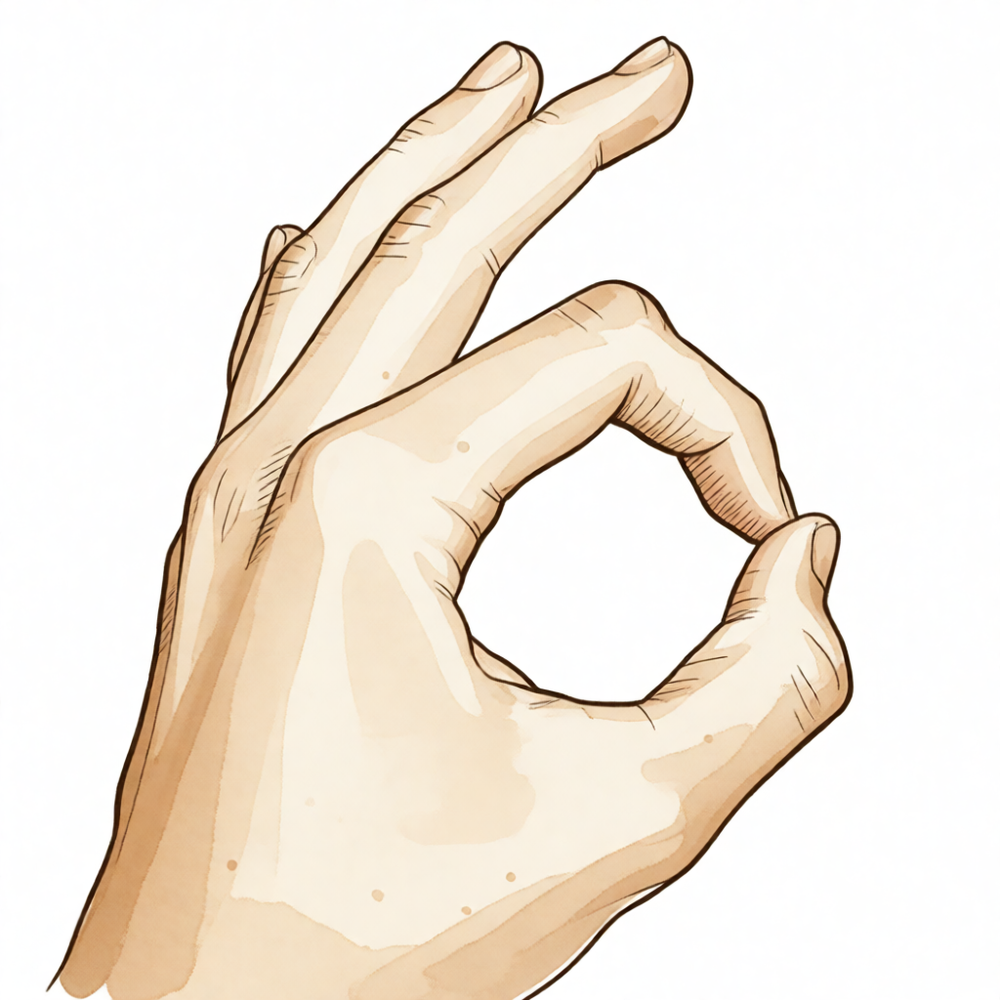
Anterior interosseous nerve (AIN) syndrome is different again. It usually causes little or no numbness. Instead it is a weakness problem: the muscles that bend the very tip of your thumb and index finger stop working properly. The classic sign is being unable to make a normal round "OK" sign: when you try to pinch the tip of your thumb to the tip of your index finger, the pinch collapses into a flat or triangular shape. Some people notice a short period of aching in the arm or shoulder first, and then the weakness appears.
What's actually happening
A single large nerve, the median nerve, runs from your neck, down the arm, across the front of the elbow and into the hand. It carries both feeling (for part of the hand) and power (to several muscles).
In pronator syndrome, the nerve gets pressed or irritated as it passes through the crowded space at the elbow and the top of the forearm. It can be squeezed by a tight band of tissue near the elbow crease (the lacertus fibrosus — when this band is the culprit, the condition is increasingly called lacertus syndrome), or as it threads between or under the muscles that turn your palm down. Because the squeeze is high up (above the wrist), the symptoms include the palm and base of the thumb, which is the main clue that separates it from carpal tunnel syndrome.
In AIN syndrome, the problem affects a deep branch of the median nerve that carries only power, no feeling, which is why there is weakness but no numbness. In many people this is not a simple "pinch" at all but more like an irritation or inflammation of the nerve (sometimes following a viral illness or for no clear reason), which is part of why it so often recovers on its own.
What we can do about it
At Mater Private Hospital Rockhampton, Dr Kieran Hirpara leads our upper-limb team in assessing these conditions through careful history and examination. We typically begin with non-surgical care, reserving surgery only if your symptoms persist despite rest and activity changes.
For all of these conditions, the first step is almost always non-surgical, and for AIN syndrome in particular that patience is usually rewarded.
Settling things down. This means modifying the activities that aggravate it (easing off the repeated twisting and heavy gripping), sometimes using a splint to rest the arm, and giving the nerve time. Simple pain-relieving measures help with the ache.
Watchful waiting. AIN weakness very often improves by itself over several months, so the usual plan is to watch and wait, frequently for around three to six months, before considering anything more. Many people regain their strength in that window without an operation. Tests such as nerve studies or a scan may be arranged along the way to confirm the diagnosis and track recovery.
Surgery is reserved for the minority who do not improve: pronator syndrome that stays painful despite a fair trial of rest and activity change, or AIN weakness that shows no sign of recovering after a period of observation. The operation releases the tight structures pressing on the nerve so it can recover. When the squeeze is at the lacertus band specifically, this can often be done through a short incision under local anaesthetic while you are awake — which lets the strength of the affected muscles be checked on the spot — and recovery is usually quick.
What to expect
These conditions generally have a good outlook. AIN syndrome in particular has a strong tendency to get better on its own, which is exactly why we don't rush to operate. Recovery is gradual, measured in months rather than weeks, so it takes some patience, and your progress will be reviewed along the way.
When non-surgical treatment isn't enough and an operation is needed, releasing the nerve typically eases the pain of pronator syndrome and gives the best chance of strength returning in AIN syndrome, although nerves recover slowly and the improvement continues to build for many months afterwards.
When to see someone
- Aching forearm pain with numbness or tingling in the thumb, index and middle fingers, especially if you also feel it in the palm and base of the thumb, and it is worse with twisting or gripping.
- Sudden difficulty making a normal "OK" sign, or weakness pinching the tip of the thumb against the index finger.
- Forearm or hand symptoms that don't settle with rest and activity changes, or weakness that is not recovering after a few months.
- A short bout of shoulder or arm aching followed by hand weakness, worth having assessed, as this pattern can point to a nerve problem that benefits from being identified early.
In more depth
Advanced reading: the deeper science (optional)
This section goes further than you need for your own treatment decisions. These syndromes are worth the extra reading because of two live debates that change the treatment: a newly popular diagnosis (lacertus syndrome) whose supporting evidence is genuinely striking but genuinely thin, and the anterior interosseous problem is increasingly thought not to be a compression at all, which means decompressing it is unlikely to be the answer.
The condition that is probably not a compression
Anterior interosseous nerve syndrome produces a characteristic weakness, an inability to bend the tip of the thumb and index finger, so the "OK" sign collapses into a pinch, with no numbness, because this branch supplies muscle only.
It was long assumed to be the nerve caught by a fibrous band, and treated accordingly. The contemporary view is different: it is increasingly thought to be a neuritis and often resolves spontaneously following prolonged observation [1]. The natural history is nearly always complete or near-complete recovery, and there is no reliable evidence that surgery can alter that natural history, so hurried surgical treatment should be avoided until good-quality studies show early intervention improves or accelerates recovery [2].
That reframing matters because the two models imply opposite actions. If a band is strangling the nerve, delay causes permanent damage and early release is urgent. If the nerve is inflamed, an operation adds a wound to a process that was going to recover, and recovery on a nerve's timescale is measured in many months, long enough that surgery performed at month six will reliably appear to have worked.
The practical guidance reflects the uncertainty rather than resolving it: surgical decompression is indicated for persistent symptoms beyond 6 months in pronator syndrome, or a minimum of 12 months in anterior interosseous nerve syndrome [1].
Pronator syndrome is a contested diagnosis
Pronator syndrome describes compression of the median nerve higher up, around the elbow, producing forearm ache with numbness in the median-supplied fingers. Because those sensory symptoms overlap almost entirely with carpal tunnel syndrome, much commoner, and readily confirmed on nerve conduction studies, the difficulty is telling them apart.
It is described in the literature as a controversial diagnosis, typically treated non-surgically over a prolonged period of approximately 12 months [1]. The features that point proximally rather than distally are numbness over the palm at the base of the thumb, supplied by a branch leaving the nerve before the carpal tunnel, and therefore spared in carpal tunnel syndrome, along with forearm tenderness and symptoms provoked by resisted forearm rotation rather than by wrist position at night [3] [5].
Lacertus syndrome: the newest name for the oldest band
The lacertus fibrosus, a fibrous sheet running from the biceps tendon across the front of the elbow, has always been on the list of structures that can pinch the median nerve. What has changed recently is the claim that it deserves top billing. A school led by the Swedish hand surgeon Elisabet Hagert argues that many people labelled with non-specific forearm fatigue, "clumsy hand", or a carpal tunnel release that failed to help, in fact have the nerve caught at exactly this point — a pattern now widely called lacertus syndrome [6].
The diagnosis is deliberately clinical, because electrical tests are usually normal in proximal median compression: weakness of three specific median-supplied muscles (the tip-benders of the thumb and index finger, and a wrist flexor) combined with tenderness directly over the band [6]. The proposed treatment is a short release under local anaesthetic with the patient wide awake, so that strength can be re-tested on the table minutes after the band is divided. Reported results are striking: in the largest published series, 93 patients improved from an average disability (QuickDASH) score of 53 before surgery to 8 immediately afterwards, grip strength rose from 16 to 24 kg, and office workers commonly returned to work within days [7].
Striking results deserve scrutiny, and the scepticism is published alongside. Tenderness over the lacertus turns out to be common in entirely healthy people, one study found it in 14 of 72 symptom-free arms (about one in five), which undermines tenderness on its own as a diagnostic sign and makes comparison with the other arm unreliable [8]. Others point out that "lacertus syndrome" is currently being used for two different problems, true nerve compression, and a muscular overuse pattern at the same site, and the one label may be stretching to cover both [9]. There are no randomised trials, follow-up in the outcome series is short, and a condition diagnosed without an objective test and treated with immediate-feedback surgery is exactly the setting in which selection and placebo effects flatter the results.
The sensible middle ground is where this page already stands: the band is real, it can compress the nerve, and when the specific pattern of weakness plus tenderness is present, a targeted release is a small operation with a quick recovery. Both the enthusiasm and the doubt are part of the current literature.
Why the patience is justified rather than merely cautious
For both conditions the recommended course is long observation, which is difficult to accept while symptoms persist. Two things make it defensible.
The first is the natural history above: for anterior interosseous nerve syndrome, recovery is the expected outcome without intervention [2]. The second is that the alternative diagnosis in a sudden-onset painful palsy is neuralgic amyotrophy, Parsonage-Turner syndrome, an inflammatory condition of the nerves that classically begins with severe shoulder or arm pain lasting days to weeks, followed by weakness as the pain subsides [4]. It is a medical condition, not a mechanical one, and no decompression addresses it.
A severe painful onset preceding the weakness is therefore the feature most worth reporting accurately, because it shifts the likely diagnosis away from compression entirely.
References for the advanced reading
- Rodner CM, Tinsley BA, O'Malley MP. Pronator syndrome and anterior interosseous nerve syndrome. J Am Acad Orthop Surg. 2013;21(5):268-75.
- Nzeako OJ, Tahmassebi R. Idiopathic anterior interosseous nerve dysfunction. J Hand Surg Am. 2015;40(11):2277-8.
- Balcerzak AA, Ruzik K, Tubbs RS, Konschake M, Podgórski M, Borowski A, et al. How to differentiate pronator syndrome from carpal tunnel syndrome: a comprehensive clinical comparison. Diagnostics (Basel). 2022;12(10):2433.
- Stutz CM. Neuralgic amyotrophy: Parsonage-Turner syndrome. J Hand Surg Am. 2010;35(12):2104-6.
- Presciutti S, Rodner CM. Pronator syndrome. J Hand Surg Am. 2011;36(5):907-9.
- Hagert E. Clinical diagnosis and wide-awake surgical treatment of proximal median nerve entrapment at the elbow: a prospective study. Hand (N Y). 2013;8(1):41-6.
- Ahmad AA, Abdullah S, Thavamany AS, Tong CY, Ganapathy SS. Lacertus syndrome: an outcome analysis after lacertus release. J Hand Surg Glob Online. 2023;5(4):498-502.
- Fang J, Zhang LQ, Tang JB. Incidence of local tenderness at the lacertus fibrosus in healthy people. J Hand Surg Eur Vol. 2025;51(1):107-8.
- Berezin PA, Zolotov AS. Lacertus syndrome: one term - two different pathologies. J Hand Surg Eur Vol. 2023;48(8):825-6.