Patients › Rehabilitation
انگلی کی سرجری
Post-operative exercises and precautions after finger surgery, including joint blocking and tendon glides.

یہ پروٹوکول Mater Private Hospital Rockhampton میں ڈاکٹر کیرن ہِرپرا کے ہاتھوں انگلی کی سرجری کے بعد آپ کی صحت یابی میں رہنمائی کرتا ہے۔ اس میں بتایا گیا ہے کہ آپریشن کے بعد کے ہفتوں میں کیا توقع رکھیں، اور ورزشوں کا وہ پروگرام دیا گیا ہے جو آپ کی انگلی اور ہاتھ میں حرکت اور کام کرنے کی صلاحیت دوبارہ حاصل کرنے میں مدد دیتا ہے۔ یہ صفحہ یا اس کی پی ڈی ایف فزیوتھراپی یا ہینڈ تھراپی کی اپنی پہلی ملاقات پر ساتھ لے جائیں تاکہ آپ کی بحالی کا علاج مربوط رہے؛ آپ کا تھراپسٹ آپ کے آپریشن اور آپ کی صحت یابی کی رفتار کے مطابق اس منصوبے میں تبدیلی کر سکتا ہے۔
اگر آپریشن کے بعد آپ کو اپنے زخم کے بارے میں کوئی تشویش ہو تو کلینک سے رابطہ کریں۔ اکثر یہ مددگار ہوتا ہے کہ زخم کی تصویر کھینچ کر جائزے کے لیے ای میل کر دیں۔
کیا توقع رکھیں
زخم کی دیکھ بھال کا طریقہ پریکٹس کے زخم کی دیکھ بھال والے ہینڈ آؤٹ (handout) میں بتایا گیا ہے۔ نیچے دی گئی ورزشیں آپ کی انگلی اور ہاتھ میں حرکت دوبارہ حاصل کرنے اور کام کرنے کی صلاحیت بحال کرنے کے لیے بنیادی اہمیت رکھتی ہیں۔
جب آپ کا زخم بھر جائے، تو یہ ورزشیں کرنے سے پہلے 20 منٹ تک اپنے ہاتھ کو گرمائش (سینک) دیں۔ ورزشیں مکمل کرنے کے بعد، سوجن یا سوزش کو کم کرنے کے لیے برف لگائیں۔
جب زخم پوری طرح بھر جائے تو زخم کے نشان کی مالش شروع کریں: چیرے کے اوپر دباؤ کے ساتھ گول گول مالش۔ زخم کے نشان کی دیکھ بھال کے بارے میں مزید معلومات کے لیے براہ کرم زخم کی دیکھ بھال والا ہینڈ آؤٹ دیکھیں۔
براہ کرم سوجن پر نظر رکھیں، اور اگر آپ کو کوئی تشویش ہو تو کلینک کو فون کریں یا کسی ہینڈ تھراپسٹ (ہاتھ کی بحالی کے ماہر) سے بات کریں۔
انگلی کے زیادہ تر آپریشنوں کے بعد صحت یابی تین اصولوں پر قائم ہوتی ہے، اور نیچے دی گئی ورزشیں ان میں سے ہر ایک پر عمل کرواتی ہیں۔ پہلا اصول ہے سوجن پر قابو: ہاتھ کی مسلسل سوجن نرم بافتوں کو اکڑا دیتی ہے اور ٹینڈنوں (tendons)، یعنی وہ مضبوط ڈوریاں جو پٹھے کو ہڈی سے جوڑتی ہیں، اور جوڑوں کی حرکت کو محدود کر دیتی ہے، اس لیے ابتدائی ہفتوں میں ہاتھ کو اونچا رکھنا (دل کی سطح سے اوپر)، ہلکی حرکت اور (جہاں ضرورت ہو) سوجن کو دل کی طرف دھکیلنے والی مالش (retrograde massage) اور دباؤ والی پٹی ترجیحات ہیں [1]۔ دوسرا اصول ہے جلد اور ہلکی حرکت: انگلیاں جلدی اکڑ جاتی ہیں، اس لیے انہیں آپ کے خاص آپریشن کے لیے مقرر حدود کے اندر حرکت دینا (جتنی جلدی آپ کا زخم اور سرجری اجازت دیں، شروع کرنا) چھوٹے جوڑوں کو لچکدار رکھتا ہے اور ٹینڈنوں کو اپنے اردگرد بھرتی ہوئی بافتوں سے چپکنے کے بجائے آزادی سے کھسکنے میں مدد دیتا ہے۔ تیسرا اصول ہے ٹینڈن کا کھسکنا (tendon gliding)۔ آپ کے ہینڈ آؤٹ میں انگلیوں کی مختلف پوزیشنیں (سیدھی، ہک، میز کی شکل اور پوری مٹھی) بلا وجہ نہیں ہیں: ہر پوزیشن انگلیوں کے گہرے اور سطحی ٹینڈنوں کو ایک دوسرے کے مقابلے میں اور ٹینڈن کے غلاف کے مقابلے میں مختلف فاصلے تک حرکت دیتی ہے، اور یہی چیز انہیں آزادی سے کھسکتا رکھتی ہے [2]۔ انگلی کے آخری جوڑ (DIP) اور درمیانی جوڑ (PIP) کو الگ سے حرکت دینے کی ورزشیں (blocking) یہی کھسکاؤ ایک ایک جوڑ پر حاصل کرتی ہیں۔ اصول یہ ہے کہ تھوڑا تھوڑا اور بار بار کریں: دن بھر باقاعدگی سے، بار بار کی جانے والی ہلکی مشق آپ کی صحت یابی کے لیے کبھی کبھار کی سخت محنت سے زیادہ فائدہ مند ہے۔
احتیاطیں اور پابندیاں
روزمرہ کے کاموں، جیسے اپنی دیکھ بھال، کھانا کھانے، کپڑے پہننے، لکھنے اور ٹائپ کرنے، کے لیے ہاتھ کا ہلکا پھلکا استعمال کرنے کی حوصلہ افزائی کی جاتی ہے (جب تک آپ کو کچھ اور نہ بتایا جائے)۔ عام طور پر آپ سے کہا جائے گا کہ آپریشن کے بعد 6 ہفتے تک نہ کوئی چیز اٹھائیں، نہ زور سے پکڑیں، نہ ہاتھ پر وزن ڈالیں اور نہ ہاتھ پر کوئی ضرب یا جھٹکا لگنے دیں؛ یہ مدت چوٹ اور کیے گئے آپریشن پر منحصر ہے۔ آپریشن کے بعد کے معائنے میں آپ کو اپنی احتیاطوں اور پابندیوں کے بارے میں مزید رہنمائی دی جائے گی۔
آپ کے فزیوتھراپسٹ کے لیے:
علاج کا طریقہ
- زخم اور زخم کے نشان کی دیکھ بھال، پریکٹس کے زخم کی دیکھ بھال والے ہینڈ آؤٹ کے مطابق؛ زخم پوری طرح بھر جانے کے بعد زخم کے نشان کی مالش (چیرے کے اوپر دباؤ کے ساتھ گول گول) شروع کریں
- زخم بھر جانے کے بعد، ورزش کے پروگرام سے پہلے 20 منٹ تک ہاتھ کو گرمائش؛ ورزشوں کے بعد سوجن اور سوزش کم کرنے کے لیے برف
- سوجن پر نظر رکھیں؛ کوئی تشویش ہو تو معاملہ کلینک یا کسی ہینڈ تھراپسٹ تک پہنچائیں
- جہاں سوجن (oedema) زیادہ ہو یا دیر سے کم ہو رہی ہو، وہاں اس پر قابو پانا ترجیح ہے: پہلے درجے پر ہاتھ کو اونچا رکھنا اور فعال حرکت، اور معمول کے علاج کے ساتھ اضافی طور پر سوجن کو دل کی طرف دھکیلنے والی مالش (retrograde massage)، دباؤ والی پٹی اور ہاتھ سے سوجن کم کرنے کی خاص تکنیک (manual oedema mobilisation) [1]
- نیچے دیے گئے کارڈوں کے مطابق گھر پر ورزش کا پروگرام: کلائی کو آگے اور پیچھے موڑنا (flexion/extension)؛ انگلی کے آخری جوڑ (distal interphalangeal، DIP) اور درمیانی جوڑ (proximal interphalangeal، PIP) کو الگ سے حرکت دینا (joint blocking)؛ ٹینڈن گلائیڈز (سیریز A اور سیریز B)
- ٹینڈن گلائیڈ اور جوڑ کو الگ سے حرکت دینے کی ترتیبیں اس طرح بنائی گئی ہیں کہ موڑنے والے ٹینڈن (flexor tendons) ایک دوسرے کے مقابلے میں اور غلاف کے مقابلے میں زیادہ سے زیادہ الگ الگ فاصلے تک کھسکیں (differential excursion): ایک ہی پوزیشن دہرانے کے بجائے پوزیشنیں (سیدھی، ہک، میز کی شکل، مٹھی) بدلتے رہیں [2]
احتیاطیں
- روزمرہ زندگی کے کاموں (اپنی دیکھ بھال، کھانا کھانا، کپڑے پہننا، لکھنا، ٹائپ کرنا) کے لیے ہاتھ کے ہلکے پھلکے استعمال کی حوصلہ افزائی کی جاتی ہے، جب تک کچھ اور نہ بتایا جائے
- آپریشن کے بعد 6 ہفتے تک نہ وزن اٹھانا، نہ زور سے پکڑنا، نہ ہاتھ پر وزن ڈالنا اور نہ کوئی ضرب یا جھٹکا (چوٹ / کیے گئے آپریشن پر منحصر)
- مخصوص احتیاطیں اور پابندیاں آپریشن کے بعد کے معائنے میں طے کی جاتی ہیں
- یہ آپریشن کے بعد انگلی کا ایک عمومی پروگرام ہے؛ جہاں کسی خاص آپریشن کی اپنی محفوظ حد، حرکت کی پابندیاں یا اسپلنٹ ہوں (مثلاً ٹینڈن کی مرمت کے بعد)، وہاں اسی آپریشن کی مخصوص ہدایات کو فوقیت حاصل ہے
یہ آپ کے ہینڈ آؤٹ والی ورزشیں ہیں، جنہیں آپ اپنے فزیوتھراپسٹ یا ہینڈ تھراپسٹ کی رہنمائی کے مطابق گھر پر جاری رکھتے ہیں۔
آپ کی ورزشیں
Kieran Hirpara 4.0
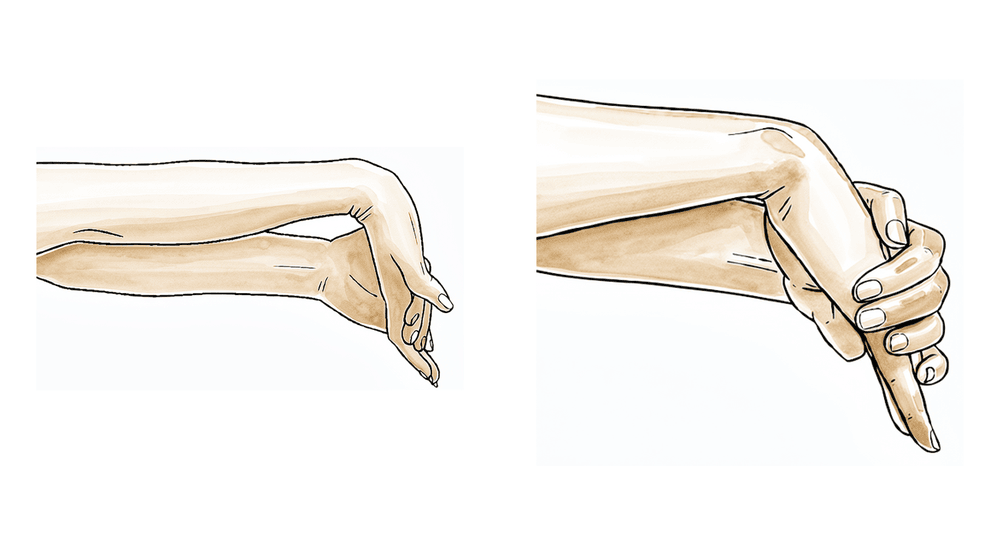
کلائی کو آگے اور پیچھے موڑنا (flexion / extension)
اپنی کہنی میز پر ٹکائیں اور کلائی کو آہستہ سے آگے پیچھے جھلائیں (یا تصویر کی طرح اسے میز یا آرام کرسی کے کنارے پر رکھیں)۔ جب زیادہ آرام محسوس ہو تو دوسرے ہاتھ سے ہتھیلی پکڑیں اور کلائی کو پیچھے کی طرف دھکیلیں تاکہ انگلیاں چھت کی طرف ہوں، پھر دوسری طرف تاکہ وہ فرش کی طرف ہوں۔ انگلیاں ڈھیلی رکھیں — وہ خود ہی مڑ جائیں گی یا سیدھی ہو جائیں گی۔ ہر اسٹریچ کو 15 سیکنڈ تک روکیں؛ ہر سمت میں 5 بار دہرائیں۔
10 بار، دن میں 4 سے 5 مرتبہ

Kieran Hirpara 4.0
انگلی کے آخری جوڑ (DIP) کو الگ سے حرکت دینا (blocking)
ہتھیلی اوپر کی طرف رکھ کر شروع کریں، اور متاثرہ ہاتھ کو دوسرے ہاتھ سے آخری جوڑ، یعنی انگلی کے سرے والے جوڑ (distal interphalangeal، DIP)، کے ذرا نیچے سے سہارا دیں۔ آخری جوڑ کو موڑیں اور سیدھا کریں، اور ہر پوزیشن کو 3 سے 5 سیکنڈ تک روکیں۔ درمیانی جوڑ کو صرف اتنا سہارا دیں کہ وہ نہ مڑے۔ اس ورزش کے دوران اگر باقی انگلیاں بھی حرکت کریں تو کوئی حرج نہیں۔
10 بار، دن میں 4 مرتبہ، روزانہ

Kieran Hirpara 4.0
انگلی کے درمیانی جوڑ (PIP) کو الگ سے حرکت دینا (blocking)
ہتھیلی اوپر کی طرف رکھ کر شروع کریں، اور متاثرہ ہاتھ کو دوسرے ہاتھ سے دوسرے جوڑ، یعنی درمیانی جوڑ (proximal interphalangeal، PIP)، کے ذرا نیچے سے سہارا دیں۔ اپنی انگلی کو درمیانی جوڑ سے موڑیں اور سیدھا کریں، اور ہر پوزیشن کو 3 سے 5 سیکنڈ تک روکیں۔ اگر باقی انگلیاں بھی حرکت کریں تو کوئی حرج نہیں۔
10 بار، دن میں 4 مرتبہ، روزانہ

Kieran Hirpara 4.0
ٹینڈن گلائیڈز — سیریز A
ہاتھ کو اپنے سامنے رکھ کر اور کلائی سیدھی رکھ کر، اپنی تمام انگلیوں کو پوری طرح سیدھا کریں (1)۔ انگلیوں کے سروں کو “ہک” (hook) کی شکل میں موڑیں، انگلیوں کے جوڑ (knuckles) اوپر کی طرف ہوں (2)۔ انگوٹھے کو انگلیوں کے اوپر رکھ کر کس کر مٹھی بنائیں (3)۔
5 سے 10 بار، دن میں 2 سے 3 مرتبہ، روزانہ

Kieran Hirpara 4.0
ٹینڈن گلائیڈز — سیریز B
ہاتھ کو اپنے سامنے رکھ کر اور کلائی سیدھی رکھ کر، اپنی تمام انگلیوں کو پوری طرح سیدھا کریں (1)۔ انگلیوں کو سب سے نچلے جوڑ سے موڑ کر اور انگلیاں سیدھی رکھ کر “میز” (tabletop) کی شکل بنائیں — دھیان رکھیں کہ آپ کی کلائی آگے کی طرف نہ جھکے (2)۔ انگلیوں کو درمیانی جوڑ سے موڑ کر انہیں ہتھیلی سے لگائیں (3)۔
5 سے 10 بار، دن میں 2 سے 3 مرتبہ، روزانہ
نیچے دی گئی ورزشیں صرف ڈاکٹر ہِرپرا اور اپنے ہینڈ تھراپسٹ کی رہنمائی کے مطابق شروع کریں، اور جو بھی حرکت کی حد اور پابندیاں آپ کو بتائی گئی ہیں ان کے اندر رہیں۔ جوڑ کو الگ سے حرکت دینے کی ورزشیں (blocking) خاص طور پر اہم ہیں: نیچے والے جوڑ کو ساکن پکڑ کر رکھنے سے حرکت اسی جوڑ پر ہونے پر مجبور ہوتی ہے جسے آپ آزاد کرنا چاہتے ہیں، نہ کہ اس جوڑ پر جو پہلے ہی آسانی سے حرکت کرتا ہے۔ ٹینڈن گلائیڈ کی سیریز موڑنے والے ٹینڈنوں (flexor tendons) کو غلاف کے اندر ہمواری سے چلتا رکھتی ہے، اور کلائی کا اسٹریچ کلائی کو اکڑنے سے روکتا ہے جبکہ توجہ انگلی پر ہوتی ہے۔ تھوڑا تھوڑا اور بار بار کرنا کبھی کبھار کے لمبے سیشنوں سے بہتر کام کرتا ہے۔ جو بھی چیز تیز درد پیدا کرے، اسے روک دیں۔
پروٹوکول کے بعد
یہ پروٹوکول پریکٹس کی صحت یابی سے متعلق عمومی ہدایات کے ساتھ مل کر کام کرتا ہے؛ آپریشن کے بعد درد پر قابو، زخم کی دیکھ بھال اور ہینڈ تھراپی کی بنیادی باتیں دیکھیں۔ جن آپریشنوں کے بعد یہ پروگرام عام طور پر استعمال ہوتا ہے، ان کے لیے ٹریگر فنگر ریلیز (انگلی کے اٹکنے کا آپریشن) اور ڈیوپٹرین کی بیماری کا آپریشن (Dupuytren's fasciectomy) دیکھیں۔
ورزشوں کا یہ پروگرام Sarah Farrell، BOccThy، تسلیم شدہ ہینڈ تھراپسٹ (Accredited Hand Therapist)، کے اشتراک سے لکھا گیا ہے۔
حوالہ جات
[1] Miller LK, Jerosch-Herold C, Shepstone L. Effectiveness of edema management techniques for subacute hand edema: a systematic review. J Hand Ther. 2017;30(4):432–446. https://pubmed.ncbi.nlm.nih.gov/28807598/ [2] Wehbé MA, Hunter JM. Flexor tendon gliding in the hand. Part II. Differential gliding. J Hand Surg Am. 1985;10(4):575–579. https://pubmed.ncbi.nlm.nih.gov/4020073/
Evidence & references
This is the clinical evidence summary written for health professionals. It is technical, and it lists the research this page was built from. You do not need to read it to understand your treatment or to make a decision about it.
Finger Surgery — General Post-operative Hand-Therapy Rehabilitation
Topic scope: This is a general post-operative finger rehabilitation program, not a single-procedure protocol. It applies as the default hand-therapy pathway after common finger operations where the repaired or released structure does not mandate its own protected range — most typically trigger finger (A1 pulley) release and Dupuytren's fasciectomy, and as a baseline mobility/oedema program after finger fracture fixation (proximal/middle phalanx ORIF or K-wire), PIP joint and volar-plate / collateral-ligament procedures, and minor soft-tissue work. The program rests on three levers the patient handout puts into practice — (1) oedema control, (2) early gentle protected movement, and (3) tendon gliding / joint-blocking to preserve differential excursion. It explicitly defers to the operation-specific protocol whenever the surgery carries a defined protected arc, motion limit or splinting regime (most importantly flexor or extensor tendon repair), which this general program does not attempt to reproduce.
Defining principle: fingers stiffen faster than almost any other joint complex in the body. The small interphalangeal joints, the gliding flexor/extensor tendons within their sheaths, and the dense soft-tissue envelope are all exquisitely sensitive to swelling and immobility — adhesions and joint contracture establish within days, not weeks. Rehabilitation is therefore a constant balancing act: protect the repaired structure for exactly the window it needs, and not one day longer, while restoring controlled glide and range early to outrun the stiffness. When in doubt, the default after finger surgery is controlled motion, not rest.
A. WHY EARLY CONTROLLED MOTION (THE CORE RATIONALE)
The unifying problem after any finger operation is the stiff finger: persistent oedema and immobility drive scar between the gliding planes, contract the joint capsule and collateral ligaments, and convert a mechanically sound repair into a functionally poor hand. The hand-surgery literature treats the stiff finger as a largely preventable complication of inadequate early rehabilitation rather than an inevitable consequence of surgery [The Stiff Finger; Stiff Digit, JAAOS].
- Immobilisation has a cost. Reduced range of motion after immobilisation arises from increased swelling, scarring between tendons and surrounding structures, and joint/ligament contracture — the exact mechanisms early motion is designed to defeat (BSSH early-mobilisation guidance).
- Adhesions establish early. The rationale for getting the patient moving — ideally with instructions given pre-operatively — and for a first therapy review at 5–7 days is to begin glide before adhesions become established (BSSH). The synthesis mirrors this: the home program starts as soon as the wound and operation allow, not at an arbitrary late milestone.
- Time to active exercise predicts the end result. In hand-fracture rehabilitation, earlier commencement of active exercise predicts greater total active range of motion at 6 weeks — a direct, measurable dose-response between early motion and outcome [Time to commencement of active exercise predicts TAM, Hand Therapy 2016].
B. EVIDENCE BY PROCEDURE GROUP
Finger fracture fixation (phalangeal ORIF / K-wire)
- The modern standard is stable fixation that permits early protected motion. Wide-awake surgery with early protected movement and pain-guided progression yields better finger ROM than rigid immobilisation (Saint John / pain-guided protocols; "better results with wide-awake surgery and early protected motion"). A systematic review and meta-analysis of mobilisation after ORIF of hand fractures supports earlier mobilisation over prolonged immobilisation for range without compromising union (ScienceDirect 2025 SR).
- Stable construct is the prerequisite. The whole early-motion strategy is contingent on the surgeon's judgement that the fixation will tolerate movement — which is why the synthesis hands the precaution set (load limits, the up-to-6-week no-lift window) back to the post-operative review. Surgeon to confirm per case.
- Minimally invasive fixation techniques are explicitly framed around preserving the soft-tissue envelope to reduce stiffness and allow early motion [Minimally Invasive Finger Fracture Management, Hand Clin].
PIP joint, volar-plate and collateral-ligament injuries
- These are stiffness-prone injuries where the management trade-off (stability vs early motion) is sharpest. The literature on PIP dislocations, fracture-dislocations and volar-plate injuries consistently favours early protected/active motion, often with buddy-strapping or a dorsal blocking approach, over static immobilisation, precisely because the PIP joint contracts so readily [PIP dislocations in athletes, Hand Clin; PIP fracture-dislocations, JBJS Rev; finger joint dislocations, Clin Sports Med].
- Buddy taping — depicted in the handout's hero image — is the canonical low-tech "protected early movement" tool here: it shares load with the neighbouring digit while permitting active glide.
Trigger finger (A1 pulley) release
- Release of the A1 pulley is a high-yield day procedure with reliably good patient-perceived recovery [Patient-Perceived Outcomes of Recovery After Trigger Digit Release, JHS 2023].
- Formal supervised therapy is usually NOT required for an uncomplicated release. A prospective randomised controlled trial found no significant difference in DASH, grip strength, ROM or pain between a structured post-operative occupational-therapy arm and a simple home-advice/ROM arm at final follow-up (RCT, PMC10671987). This validates the synthesis framing this as a home program with therapy escalation reserved for those who are slow to settle, stiff or swollen — not mandated for everyone.
Dupuytren's fasciectomy
- Therapy after fasciectomy centres on oedema and wound management, a home exercise program, and night extension splinting — a typical "brief" protocol runs 4 sessions (days 0-3, 2 wk, 4 wk, 8 wk) with a night extension orthosis to ~3 months (post-fasciectomy rehab trials).
- Routine night-splinting for all is contested. The SCoRD-type trials and subsequent work show static night splinting does not clearly improve ROM over hand therapy alone for unselected patients — splinting is best targeted at those losing extension, not applied universally [SCoRD protocol; Dutch Multidisciplinary Guideline on Dupuytren Disease].
- For established post-fasciectomy or post-fracture flexion stiffness, casting motion to mobilise stiffness (CMMS) is an evidence-supported salvage technique to regain digital flexion [Casting motion to mobilise stiffness, Hand Therapy 2010].
C. OEDEMA, SCAR AND STIFFNESS MANAGEMENT
- Oedema control is first-line and non-negotiable. Persistent hand oedema stiffens the soft tissues and degrades both ROM and function. The best systematic review of subacute hand oedema management concluded that active exercise enabling tendon gliding and muscular contraction acts as a pump to drive oedema away from the periphery, and supports elevation and active movement as first-line, with retrograde massage, compression and manual oedema mobilisation as adjuncts — there is no single superior modality, so the program layers them [Miller, Jerosch-Herold & Shepstone, J Hand Ther 2017]. This is reference [1] in the synthesis.
- Tendon gliding works through differential excursion. The straight / hook / tabletop / full-fist positions are not interchangeable repetitions: each moves the FDP relative to the FDS and relative to the sheath by a different amount, and it is this differential glide that keeps the tendons from scarring to one another and to the sheath [Wehbe & Hunter, J Hand Surg Am 1985 — reference [2] in the synthesis]. Joint-by-joint DIP and PIP blocking isolates the same glide at a single joint.
- Scar management. Once the wound is healed, scar massage and desensitisation reduce adherent scar over the incision — relevant to every open finger procedure and the surgical interval through which the tendons must glide.
- Heat before, ice after the exercise session is a standard hand-therapy adjunct to improve tissue extensibility for movement and settle the post-exercise inflammatory flare (consensus practice).
Phased timeline (maps to the synthesis sections)
| Phase | Window | Protect | Motion / glide | Oedema & scar | Notes |
|---|---|---|---|---|---|
| I — Settle & protect | Week 0-~2 | Protect per the specific operation (buddy tape / splint / load limits as set at review); light functional use for self-care, dressing, writing, typing | Begin gentle active motion within the operation's limits; tendon glides and DIP/PIP blocking as the wound and fixation allow | Elevation + active movement first-line for swelling; wound care per handout | First therapy review ideally 5-7 days to start glide before adhesions set (BSSH). No lifting/gripping/impact |
| II — Restore glide & range | Week ~2-6 | Wean protection as the structure consolidates; precautions confirmed at post-op review | Progress active ROM, full tendon-glide series, joint blocking; buddy strapping for PIP/collateral injuries | Once healed: commence scar massage (firm circles); heat before / ice after exercises; retrograde massage + compression if oedema persists | Most ROM is won in this window — frequent gentle practice beats occasional hard effort |
| III — Strengthen & return | Week ~6-12 | Protection generally off (operation-dependent) | Restore full ROM; introduce grip and functional strengthening | Continue scar work until mature; night extension splint to ~3 mo if losing extension (Dupuytren) | Return to lifting/gripping/impact from ~6 weeks per the operation; escalate persistent stiffness to hand therapy / CMMS |
Phase windows are typical and consensus-based; the operation-specific protocol and the surgeon's post-operative review override any timing here.
D. KEY CONTROVERSIES / EVIDENCE QUALITY
- Universal supervised therapy vs home program. For simple procedures (trigger finger release) an RCT shows no benefit of routine formal therapy over good home advice — supporting a targeted therapy model. For complex/stiffness-prone injuries (PIP, fracture-dislocation, fracture ORIF) early supervised hand therapy is far more clearly beneficial. The synthesis correctly pitches a home program with therapist escalation rather than mandating identical input for every operation. Moderate.
- Night-splinting after Dupuytren's fasciectomy. Routine static night splinting is not supported for unselected patients (SCoRD, Dutch guideline); reserve it for those demonstrably losing extension. Moderate (RCT/guideline).
- How early, and how much, to move a fixed fracture. Early protected motion is favoured, but it is strictly contingent on a stable construct — a judgement only the operating surgeon can make. The "early motion is better" evidence assumes adequate fixation. Moderate (SR), construct-dependent.
- The general protocol itself is a consensus scaffold. A single "finger surgery" rehab program necessarily generalises across heterogeneous operations; its three principles (oedema, early motion, glide) are very well supported, but the exact dosing/timing is expert-consensus, individualised by the treating therapist and surgeon.
E. EVIDENCE STRENGTH FLAGS (summary)
- STRONG: oedema control via elevation + active tendon-gliding exercise as first-line (SR, J Hand Ther 2017); tendon differential-excursion rationale for the varied glide positions (mechanistic, Wehbe & Hunter); early motion reduces stiffness/adhesions after finger surgery (consistent across the stiff-finger and BSSH literature).
- MODERATE (RCT / SR / guideline): early mobilisation > immobilisation after hand-fracture ORIF (SR + meta-analysis, 2025); time-to-active-exercise predicts 6-week TAM; no added benefit of routine formal therapy after simple trigger-finger release (RCT); selective (not universal) night splinting after Dupuytren's fasciectomy (SCoRD/Dutch guideline).
- WEAK / CONSENSUS: the precise phase windows and exercise dosing in this general program (expert hand-therapy consensus, individualised); heat-before/ice-after adjunct; the principle that operation-specific protocols override this general scaffold (sound clinical practice, not trial-derived).
CITATIONS
RAG corpus (180,000+ Orthopaedic articles)
- Time to commencement of active exercise predicts total active range of motion 6 weeks after hand-fracture fixation. Hand Therapy. 2016. DOI: 10.1177/1758998316679386
- Hardy MA. The Stiff Finger. Hand Clinics. 2010. DOI: 10.1016/j.hcl.2010.02.001
- Etiology, Evaluation, and Management Options for the Stiff Digit. JAAOS. DOI: 10.5435/jaaos-d-18-00310
- Phalangeal neck fractures of the proximal phalanx of the fingers in adults. Injury. 2010. DOI: 10.1016/j.injury.2010.06.017
- Minimally Invasive Finger Fracture Management. Hand Clinics. 2013. DOI: 10.1016/j.hcl.2013.08.014
- Management of Proximal Interphalangeal Joint Dislocations in Athletes. Hand Clinics. 2009. DOI: 10.1016/j.hcl.2009.05.008
- Treatment of Proximal Interphalangeal Joint Fracture-Dislocations. JBJS Reviews. DOI: 10.2106/jbjs.rvw.o.00019
- Management of Finger Joint Dislocation and Fracture-Dislocations in Athletes. Clinics in Sports Medicine. 2019. DOI: 10.1016/j.csm.2019.10.006
- Patient-Perceived Outcomes of Recovery After Trigger Digit Release. J Hand Surg Am. 2023. DOI: 10.1016/j.jhsa.2023.03.016
- Comparative Study of A1 Pulley Release and Ulnar Superficialis Slip Resection (trigger digit). J Hand Surg Am. 2022. DOI: 10.1016/j.jhsa.2022.04.021
- Use of casting motion to mobilize stiffness (CMMS) to regain digital flexion. Hand Therapy. 2010. DOI: 10.1258/ht.2010.010008
- Dutch Multidisciplinary Guideline on Dupuytren Disease. J Hand Surg Glob Online. 2022. DOI: 10.1016/j.jhsg.2022.11.008
- Factors affecting functional recovery after surgery and hand therapy in Dupuytren's patients. J Hand Ther. 2014. DOI: 10.1016/j.jht.2014.11.006
- Rehabilitation Regimens Following Surgical Repair of Extensor Tendon Injuries of the hand. DOI: 10.1007/s12593-012-0075-x
Hand-therapy / rehabilitation literature (URLs)
- Miller LK, Jerosch-Herold C, Shepstone L. Effectiveness of edema management techniques for subacute hand edema: a systematic review. J Hand Ther. 2017;30(4):432-446. https://pubmed.ncbi.nlm.nih.gov/28807598/
- Wehbe MA, Hunter JM. Flexor tendon gliding in the hand. Part II. Differential gliding. J Hand Surg Am.
- https://pubmed.ncbi.nlm.nih.gov/4020073/
- Systematic review and meta-analysis of mobilisation following ORIF of hand fractures. ScienceDirect.
- https://www.sciencedirect.com/science/article/pii/S1748681525003109
- Better results of finger fractures with wide-awake surgery and early protected motion. PMC. https://www.ncbi.nlm.nih.gov/pmc/articles/PMC4445035/
- The effectiveness of rehabilitation after open surgical release for trigger finger: a prospective, randomized, controlled study. PMC. https://www.ncbi.nlm.nih.gov/pmc/articles/PMC10671987/
- Splinting after contracture release for Dupuytren's contracture (SCoRD): RCT protocol. PMC. https://www.ncbi.nlm.nih.gov/pmc/articles/PMC2386788/
Published rehab protocols (patient-guidance / society — basis for the phase structure)
- The British Society for Surgery of the Hand (BSSH) — Guidelines. https://www.bssh.ac.uk/professionals/guidelines.aspx
- Pain-Guided Hand Therapy for early protected movement of finger fractures (The Saint John Protocol), ASSH. https://handsurgery.org/multimedia/files/preCourse/Pain%20Guided%20Hand%20Therapy%20for%20early%20protected%20movement%20finger%20fractures.pdf
- Rehabilitative Strategies Following Hand Fractures. Hand Clinics. https://www.hand.theclinics.com/article/S0749-0712(13)00066-8/fulltext
- University of Kentucky HealthCare — Hand Rehabilitation Protocols. https://ukhealthcare.uky.edu/sites/default/files/m21-0609_ortho_protocols-final.pdf