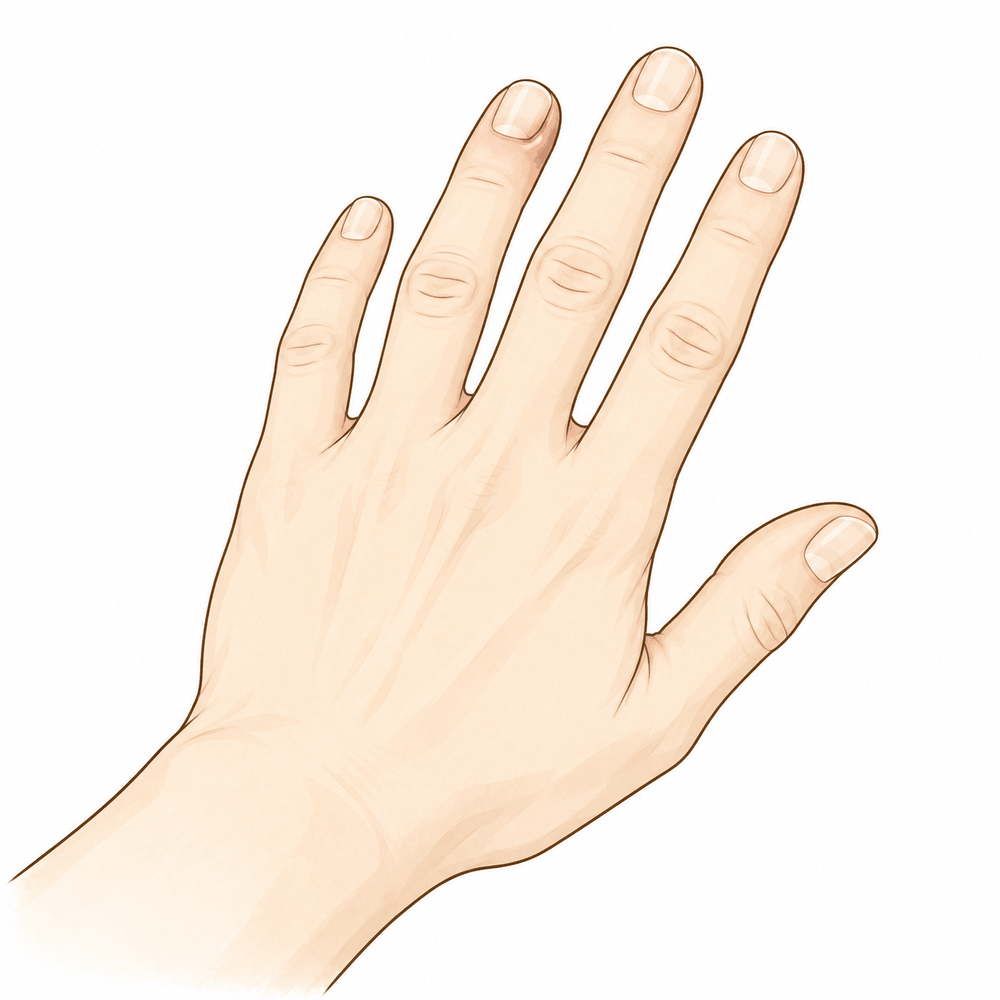
Qué está sintiendo
La paroniquia es una infección o inflamación del pliegue de piel situado junto a la uña. Puede aparecer de forma rápida o desarrollarse lentamente, y las dos formas se sienten de manera diferente.
La forma rápida suele empezar después de un padrastro, de morderse la uña o de una pequeña lesión en la piel junto a la uña. En uno o dos días, el pliegue se vuelve sensible, se hincha y se enrojece, y puede acumularse pus bajo ese pliegue. El dolor es agudo y pulsátil, y se localiza justo en el borde de la uña, no más arriba en el dedo. Las tareas cotidianas que presionan la punta del dedo se vuelven difíciles: recoger monedas, teclear, abrocharse botones o agarrar un hervidor.
La forma lenta se desarrolla a lo largo de seis semanas o más. La hinchazón y el enrojecimiento son más leves, pero el pliegue sigue dolorido e hinchado. El pliegue de piel puede separarse de la uña, y la propia uña puede presentar estrías, surcos o cambios de color. Suele empeorar después de que las manos hayan estado mojadas durante un rato, por lo que fregar los platos, ducharse o una jornada de trabajo en condiciones húmedas pueden desencadenarla. El trabajo repetido con las manos mojadas, el lavado frecuente de manos o el daño en la cutícula por la manicura pueden mantenerla activa. Si no se trata, los brotes dolorosos siguen reapareciendo.
Si el enrojecimiento, la hinchazón y el dolor se extienden hacia arriba por el dedo, o si tiene fiebre, acuda al servicio de urgencias ese mismo día. No necesita una derivación.
¿Qué está ocurriendo realmente?
La uña se asienta en un bolsillo de piel bien ajustado. El pliegue de piel que enmarca la uña en su base y a los lados funciona como una junta de goma: sella la uña contra el dedo y mantiene el agua, la suciedad y los gérmenes fuera de las capas inferiores. La paroniquia es lo que ocurre cuando ese sellado se rompe.
En la forma rápida, las bacterias entran a través de un padrastro, un mordisco o un pequeño corte junto a la uña. El cuerpo envía líquido y células que combaten la infección, y el pus se acumula en ese bolsillo cerrado. Como el bolsillo apenas puede estirarse, es la presión la que provoca ese dolor agudo y pulsátil justo en el borde de la uña.
La forma lenta es diferente. No es principalmente una infección. Empieza cuando la cutícula, el pequeño sellado en la base de la uña, se daña por el trabajo con las manos mojadas, el lavado frecuente de manos, la manicura o una sustancia irritante. Una vez que ese sellado desaparece, el agua y los irritantes penetran en el pliegue y este se inflama. Un pliegue hinchado no puede volver a apoyarse sobre la uña, por lo que se queda levantado y retiene la humedad, y los gérmenes se instalan en ese hueco húmedo. La levadura que suele encontrarse ahí es más un pasajero que una causa. La irritación continua también altera la capa situada bajo la cutícula que produce la uña, y por eso aparecen estrías y surcos. Cada brote impide que el sellado se repare, de modo que el problema se mantiene por sí solo.
Si el pus no se trata, puede avanzar por debajo de la uña o rodearla hasta el otro lado del dedo.
Qué podemos hacer al respecto
El Dr. Kieran Hirpara, cirujano de extremidades superiores en el Mater Private Hospital Rockhampton, comienza con las opciones menos invasivas que se adapten a su condición. Por lo general, los pacientes son derivados a nuestra clínica por su médico de cabecera; si un fisioterapeuta le ha sugerido consultarnos, igualmente necesitará una derivación de su médico de cabecera para poder acceder al reembolso de Medicare. Valoramos su mano, examinamos el pliegue ungueal y solicitamos estudios de imagen solo si son necesarios.
En la forma lenta, el autocuidado es lo primero. Proteger los pliegues ungueales importa más que cualquier crema: mantenga las manos secas, use guantes para las tareas con agua y deje de arrancarse o cortarse la cutícula. Es posible que le recetemos una crema o pomada con esteroides para aplicar sobre el pliegue, que calma la inflamación. En esta forma, las cremas aplicadas sobre el pliegue funcionan mejor que los comprimidos. Dele varias semanas y mantenga la rutina de manos secas y protegidas incluso cuando la piel mejore, porque el sellado necesita tiempo para repararse.
En la forma rápida con pus, es posible que le recetemos antibióticos en comprimidos, a veces junto con baños de agua tibia con sal en casa. El calor puede ayudar a que una pequeña acumulación de pus drene por sí sola. Si ya se ha acumulado pus bajo el pliegue, normalmente es necesario liberarlo en lugar de tratarlo solo con antibióticos. Un tratamiento temprano puede resolver el problema en pocos días sin extraer ninguna parte de la uña.
Si la forma lenta no ha mejorado tras probar estas medidas durante un tiempo razonable, se considera la cirugía. La operación extirpa una porción en forma de media luna del pliegue de piel engrosado e inflamado en la base de la uña, lo que permite que el pliegue cicatrice de nuevo sobre la uña y vuelva a sellarla. Si la propia uña se ha vuelto irregular o con estrías, extraer la lámina ungueal en la misma operación mejora el resultado. Hablaremos con usted sobre si la cirugía es adecuada para su dedo y lo decidiremos juntos.
Qué esperar
La forma rápida suele resolverse bien cuando se trata pronto. Muchas personas se curan sin que sea necesario extraer ninguna parte de la uña. Una vez que se libera el pus y el pliegue de piel puede cicatrizar, el dolor disminuye y el dedo vuelve a la normalidad en el transcurso de días o semanas.
La forma lenta tarda más. Es una afección que aparece y desaparece: empeora después de trabajar con las manos mojadas y mejora cuando el pliegue está protegido. Con un cuidado constante (mantener las manos secas y la cutícula intacta importa más que cualquier crema), la separación entre el pliegue de piel y la uña se rellena en un plazo de 6 a 8 semanas y el sellado se repara por sí solo. Algunas personas necesitan varios meses de esta rutina antes de que el pliegue se recupere definitivamente. Si no se trata, los brotes dolorosos siguen reapareciendo, y la uña puede engrosarse y desarrollar estrías o surcos duraderos.
La cirugía de la forma lenta extirpa el pliegue engrosado para que pueda cicatrizar de nuevo sobre la uña. Los dedos cuya uña se ha mantenido lisa suelen curarse solo con la cirugía del pliegue. Cuando la uña ya presenta estrías o irregularidades, extraer la lámina ungueal en la misma operación aumenta la probabilidad de que el problema no vuelva a aparecer. Por lo general, no se necesitan antibióticos después de la cirugía para esta afección en personas sin otros problemas de salud.
Conviene saber algunas cosas a lo largo del proceso. Las infecciones de la mano pueden dar lugar a complicaciones difíciles de controlar, así que no conviene ignorar un dedo que no mejora. Si sus síntomas no mejoran, empeoran a lo largo de las semanas, le despiertan por la noche o le impiden trabajar o usar la mano, consulte a su médico de cabecera o pida una valoración por un especialista.
¿Cuándo consultar a un médico?
La mayoría de las infecciones del pliegue ungueal se resuelven con un cuidado temprano, pero algunos signos indican que no debe esperar. Acuda a un servicio de urgencias ese mismo día si el dedo se pone caliente, rojo, hinchado y doloroso, sobre todo si tiene fiebre, o si el pus se extiende hacia arriba por el dedo. No necesita una derivación. Las infecciones de la mano pueden dar lugar a complicaciones difíciles de controlar una vez que se establecen, por lo que es importante recibir atención ese mismo día.
Acuda a su médico de cabecera si el dolor y la hinchazón duran seis semanas o más, o si el pliegue sigue empeorando después de trabajar con las manos mojadas a pesar de mantenerlo seco y protegido. Solicite una valoración por un especialista si el pliegue de piel sigue levantado e hinchado, si la uña desarrolla estrías o surcos, o si un problema de la uña no responde a las cremas. Un pliegue ungueal que no mejora tras un tratamiento adecuado necesita un examen más detenido, porque a veces otras causas se confunden con esta afección.
En profundidad
Advanced reading: the deeper science (optional)
Esta sección va más allá de lo necesario para que usted tome decisiones sobre su propio tratamiento. La paroniquia merece una lectura adicional, ya que un solo término engloba dos afecciones que se comportan de manera distinta, responden a tratamientos opuestos y suelen confundirse. Además, la solución quirúrgica para la forma crónica es más antigua, sencilla y cuenta con mayor respaldo científico de lo que la mayoría de las personas piensan.
Dos afecciones, un mismo nombre
La paroniquia aguda es una infección bacteriana del pliegue ungueal, generalmente causada por Staphylococcus aureus, que se desarrolla en un plazo de 24 a 48 horas tras la ruptura del sellado entre la uña y la piel [1]. Se caracteriza por enrojecimiento, calor, tensión y un dolor desproporcionado; además, se forma pus.
La paroniquia crónica, definida convencionalmente como aquella que persiste más de seis semanas, en realidad no es una infección en sí. Se trata de una dermatitis inflamatoria del pliegue ungueal provocada por exposición repetida al agua y a irritantes; la pérdida del sellado cuticular permite la entrada de más irritantes, generando un ciclo que se perpetúa [2]. En estos pliegues suele aislarse Candida, motivo por el cual durante mucho tiempo se consideró una infección fúngica; sin embargo, actualmente se entiende mejor como una colonización de un pliegue ya dañado, y no como su causa.
El ensayo que redefinió la forma crónica de la enfermedad
La evidencia definitiva proviene de un ensayo aleatorizado, doble ciego y con doble simulacro, en el que se comparó un esteroide tópico (aceponato de metilprednisolona) con dos antifúngicos sistémicos. De los 48 uñas tratadas con el esteroide tópico, 41 presentaron mejoría o curación, frente a 30 de 57 en el grupo tratado con terbinafina y 29 de 64 en el grupo tratado con itraconazol; esto representa una ventaja estadísticamente significativa para el esteroide [3].
Ese mismo ensayo aporta una observación aún más decisiva: la presencia de Candida no guarda una relación estricta con la actividad de la enfermedad, y la erradicación de dicha levadura solo se asoció con curación clínica en 2 de los 18 pacientes que la tenían al inicio del estudio [3].
Esto resulta difícil de conciliar con una etiología fúngica, pero fácil de explicar desde un punto de vista inflamatorio: la levadura actúa simplemente como un “pasajero” en un pliegue cutáneo dañado, no como la causa principal de la enfermedad. Esto lleva a redefinir la patología como un problema de barrera cutánea: la cutícula funciona como un sello protector; el contacto continuo con agua la deteriora, el pliegue se hincha y, al hincharse, pierde su capacidad de sellarse, permitiendo así la colonización por microorganismos. Tratar dichos colonizadores no corrige, sin embargo, el mecanismo subyacente.
La consecuencia práctica de esto es poco atractiva y, precisamente, la parte que los pacientes suelen omitir: la intervención más eficaz consiste en mantener las manos secas y alejadas de sustancias irritantes. En este sentido, el uso de guantes resulta más efectivo que cualquier medicación recetada.
Paroniquia aguda: drenaje y cuánto se debe alterar la zona
Una vez que se forma pus, los antibióticos por sí solos no logran resolver el problema; es necesario drenar el acúmulo de pus [1].
El método tradicional consiste en separar el pliegue ungueal de la lámina ungueal para descomprimir el absceso, extirpando además parte de la uña donde el pus se ha acumulado debajo.
Una alternativa que preserva la uña es la técnica del “rollo suizo”: en ella se eleva el pliegue ungueal y se enrolla sobre un punto de sutura, en lugar de realizar una incisión o resección; este rollo se mantiene durante unos días y luego se desenrolla [4]. Su ventaja radica en que permite drenar el pus que se ha extendido por todo el pliegue sin dañar ni la lámina ungueal ni el pliegue mismo, algo crucial cuando la alternativa sería realizar una incisión más amplia.
En ambos métodos, el principio general es que la incisión debe descomprimir el pliegue ungueal sin penetrar en la pulpa digital, ya que esta constituye un compartimento independiente; abrirla convertiría una paroniquia sencilla en una herida mucho más compleja de tratar.
Marsupialización de la eponiquia
En casos de paroniquia crónica que no mejora, se emplea una técnica descrita en 1976 y que prácticamente no ha variado desde entonces.
El procedimiento de Keyser y Eaton consiste en extirpar una porción en forma de media luna del pliegue ungueal proximal engrosado, eliminando el tejido inflamado pero sin afectar la matriz germinativa; luego se deja la herida abierta para que cicatrice por contracción. Esta contracción hace que el pliegue vuelva a situarse sobre la lámina ungueal, restaurando el sellado que la enfermedad había roto [5].
La anatomía es lo que hace crítica la preservación de dicha zona. Debajo de la cutícula se encuentra un espacio ciego de dos a tres milímetros de profundidad que contiene la matriz germinativa, responsable de la formación de la lámina ungueal; la capa subcutánea que lo cubre determina la superficie de la uña. Si esta capa se altera por infección, presión o traumatismo, la producción de la uña se ve afectada en proporción: episodios breves generan surcos transversales, mientras que una enfermedad prolongada provoca los surcos longitudinales y el engrosamiento característicos de la paroniquia crónica [5].
Por ello, preservar la matriz germinativa evita deformidades ungueales permanentes; además, dejar la herida abierta permite esa contracción que vuelve a sellar el pliegue; cerrarla, en cambio, anularía el objetivo del procedimiento.
La mejora que eliminó las recurrencias
El dato de resultado más útil es una serie pequeña de casos con una comparación interna clara. Como se ha reportado, los dedos con irregularidades ungueales tratados únicamente mediante marsupialización presentaron recurrencias en una minoría de casos; en cambio, otro grupo de dedos con irregularidades ungueales tratados mediante marsupialización sumada a la extracción de la lámina ungueal no presentaron recurrencias. Los dedos sin irregularidades ungueales sanaron con marsupialización sola [6].
Dicha serie es pequeña y los casos se trataron de forma secuencial, no aleatorizada; por lo tanto, esto constituye más bien una indicación que una prueba concluyente. Además, no tuvimos acceso al texto completo, de modo que las cifras mencionadas provienen de resúmenes en literatura secundaria y no del artículo original. No obstante, esto aporta una regla quirúrgica concreta: una uña irregular o con surcos indica que la enfermedad ya ha afectado a la matriz ungueal; en esos dedos, también debe extraerse la lámina ungueal. En cambio, si la uña tiene aspecto normal, puede dejarse intacta.
Se trata de un hallazgo excepcionalmente útil para una patología tan frecuente; por ello, antes de decidir sobre la intervención, merece la pena examinar el estado de la lámina ungueal, no solo el pliegue cutáneo.
Referencias
[1] Ritting AW, O'Malley MP, Rodner CM. Paroniquia aguda. J Hand Surg Am. 2012;37(5):1068-70. https://doi.org/10.1016/j.jhsa.2011.11.021
[2] Shafritz AB, Coppage JM. Paroniquia aguda y crónica de la mano. J Am Acad Orthop Surg. 2014;22(3):165-74. https://doi.org/10.5435/JAAOS-22-03-165
[3] Tosti A, Piraccini BM, Ghetti E, Colombo MD. Corticosteroides tópicos frente a antifúngicos sistémicos en el tratamiento de la paroniquia crónica: estudio abierto, aleatorizado, doble ciego y doble simulacro. J Am Acad Dermatol. 2002;47(1):73-6. https://doi.org/10.1067/mjd.2002.122191
[4] Pabari A, Iyer S, Khoo CTK. Técnica del “rollo suizo” para el tratamiento de la paroniquia. Tech Hand Up Extrem Surg. 2011;15(2):75-7. https://doi.org/10.1097/BTH.0b013e3181ec089e
[5] Keyser JJ, Eaton RG. Curación quirúrgica de la paroniquia crónica mediante marsupialización de la eponiquia. Plast Reconstr Surg. 1976;58(1):66-70. https://doi.org/10.1097/00006534-197607000-00011
[6] Bednar MS, Lane LB. Marsupialización de la eponiquia y extracción de la uña como tratamiento quirúrgico de la paroniquia crónica. J Hand Surg Am. 1991;16(2):314-7. https://doi.org/10.1016/S0363-5023(10)80118-2
Evidence & references
This is the clinical evidence summary written for health professionals. It is technical, and it lists the research this page was built from. You do not need to read it to understand your treatment or to make a decision about it.
Overview
- In chronic paronychia, C. albicans involvement was found in the outer epidermis with mycelium, but without involvement of the dermis [1].
- Candida albicans was recovered in approximately 15% of paronychia cases [3].
- Untreated paronychial infection can cross the eponychium to the contralateral paronychial fold, course anteriorly into the pulp tissue, and decompress into the periosteum and distal tuft, causing osteomyelitis and necrosis [5].
Anatomy & Pathophysiology
Microbiology & Histopathology
- In chronic paronychia, C. albicans involvement is present in the outer epidermis with mycelium, but there is no involvement of the dermis [1].
Surgical Anatomy & Pathology
- In recalcitrant cases of chronic paronychia, surgical treatment may include en bloc excision of the proximal nail fold or eponychial marsupialization, with or without nail plate removal [2].
Clinical Presentation
- Candida albicans was recovered in about 15% of paronychia cases [3].
- In a patient with habitual nail biting, an untreated paronychial infection crossed the eponychium to the contralateral paronychial fold, coursed anteriorly into the pulp tissue, and decompressed into the periosteum and distal tuft, causing osteomyelitis and necrosis [5].
Investigations
- In chronic paronychia, C. albicans involvement was found in the outer epidermis with mycelium, but no involvement of the dermis was observed [1].
- A careful physical examination is essential to direct care and future testing, as diagnostic tests such as imaging and serum laboratory studies can be expensive, time-consuming, and often nonspecific [27].
Treatment
Operative
- In recalcitrant cases of chronic paronychia, surgical treatment may include en bloc excision of the proximal nail fold [2].
- In recalcitrant cases of chronic paronychia, surgical treatment may include eponychial marsupialization [2].
- Surgical treatment for recalcitrant chronic paronychia may be performed with or without nail plate removal [2].
- The eponychial folding flap demonstrated statistically superior outcomes in terms of apparent nail-plate exposure compared to rectangle recession after fingertip amputation [15].
- The mean difference in apparent nail-plate exposure between the eponychial folding flap and rectangle recession was 0.61 mm (95% CI, 0.35—0.87 mm; P < .001) [15].
- The eponychial folding flap demonstrated statistically superior aesthetic satisfaction compared to rectangle recession after fingertip amputation [15].
- The eponychial folding flap demonstrated statistically superior postoperative pain outcomes compared to rectangle recession after fingertip amputation [15].
- The application of the eponychial flap allowed a nail lengthening ranging from 28.5 to 80% of the exposed nail body [9].
Non-Operative
- In chronic paronychia, C. albicans involvement is present in the outer epidermis with mycelium [1].
- In chronic paronychia, C. albicans involvement does not extend to the dermis [1].
- The nail should be retained whenever possible because it can be used as a splint and simultaneous waterproof dressing in many finger tip injuries [12].
- Retaining the nail eliminates most of the pain attributable to exposure of the nail bed in many cases [12].
Complications
- In recalcitrant cases of chronic paronychia, surgical treatment may include en bloc excision of the proximal nail fold or an eponychial marsupialization, with or without nail plate removal [2].
Recovery
- The eponychial folding flap demonstrated statistically superior outcomes in terms of apparent nail-plate exposure compared to rectangle recession, with a mean difference of 0.61 mm (95% CI, 0.35—0.87 mm; P < .001) [15].
- The eponychial folding flap demonstrated statistically superior outcomes in terms of aesthetic satisfaction compared to rectangle recession [15].
- The eponychial folding flap demonstrated statistically superior outcomes in terms of postoperative pain compared to rectangle recession [15].
Key Evidence
- [L4] Each lesion studied had C. albicans involvement with mycelium in the outer epidermis but no involvement of the dermis. [1] (10.1001/archderm.1962.01590090066015)
- [L4] In recalcitrant cases, surgical treatment may be resorted to, which includes en bloc excision of the proximal nail fold or an eponychial marsupialization, with or without nail plate removal. [2] (10.4103/0019-5154.123482)
- [L4] Candida albicans was recovered in about 15% of the cases. [3] (10.1016/0266-7681(93)90063-l)
- [L5] This patient with habitual nail biting developed a paronychial infection, which untreated, crossed the eponychium to the contralateral paronychial fold, coursed anteriorly into the pulp tissue, and finally decompressed into the periosteum and distal tuft, causing osteomyelitis and necrosis. [5] (10.1016/s0363-5023(05)80062-0)
- [L4] The application of the eponychial flap allowed a nail lengthening ranging from 28.5 to 80% of the exposed nail body. [9] (10.1016/s0363-5023(03)80451-3)
- [L5] The nail should be retained whenever possible because it can be used as a splint and simultaneous waterproof dressing in many finger tip injuries, and in many cases eliminates most of the pain attributable to exposure of the nail bed. [12] (10.1016/s0266-7681(84)80030-3)
- [L4] The eponychial folding flap demonstrated statistically superior outcomes in terms of apparent nail-plate exposure (mean difference 0.61 mm; 95% CI, 0.35—0.87 mm; P < .001), aesthetic satisfaction, and postoperative pain, without compromising scar quality or functional recovery. [15] (10.1016/j.jhsg.2026.101101)
References
[1] Chronic Paronychia. Archives of Dermatology. 1962. DOI: 10.1001/archderm.1962.01590090066015
[2] Management of chronic paronychia. Indian Journal of Dermatology. 2014. DOI: 10.4103/0019-5154.123482
[3] Paronychia: a Mixed Infection. Journal of Hand Surgery. 1993. DOI: 10.1016/0266-7681(93)90063-l
[5] Eikenella osteomyelitis in a chronic nail biter: A case report. The Journal of Hand Surgery. 1995. DOI: 10.1016/s0363-5023(05)80062-0
[9] The eponychial flap: A new technique to restore the length of a short nail. The Journal of Hand Surgery. 2003. DOI: 10.1016/s0363-5023(03)80451-3
[12] The Best Dressing for a Nail Bed is the Nail Itself. Journal of Hand Surgery. 1984. DOI: 10.1016/s0266-7681(84)80030-3
[15] Comparative Outcomes of Rectangle Recession Versus Eponychial Folding Flaps for Nail-Plate Length After Fingertip Amputation. Journal of Hand Surgery Global Online. 2026. DOI: 10.1016/j.jhsg.2026.101101
[27] Orthopaedic Knowledge Update 13 Ebook Without Multimedia. Anatomy, Evaluation, Clinical Examination, and Imaging > Evaluation and Clinical Examination: Current Concepts.