Patients › Hand
Vaina flexora infectada (tenosinovitis piogénica flexora)
Qué está sintiendo
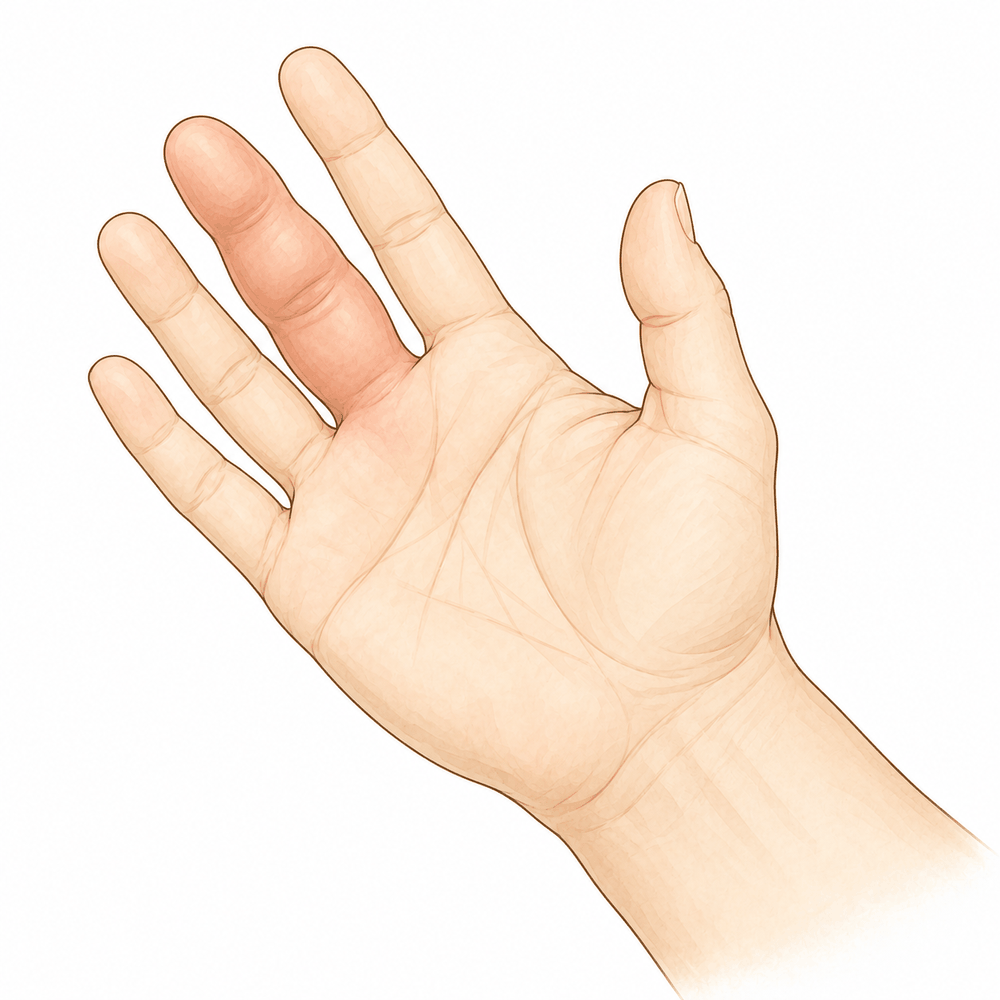
Una vaina del flexor infectada es una infección en el túnel por el que se desliza el tendón que dobla el dedo. Todo el dedo suele hincharse de manera uniforme, a lo largo de toda su longitud, en lugar de en un único punto doloroso. El dedo puede quedar en una posición ligeramente doblada y costar estirarlo. Estirarlo, o que alguien se lo estire con suavidad, suele ser lo que más duele, sobre todo cerca de la base del dedo, donde puede verse la hinchazón.
El dolor se siente a lo largo del trayecto del tendón, desde la base del dedo hacia la palma, y no sobre una sola articulación. Tiende a estar presente todo el tiempo y empeora cuando se fuerza el dedo a estirarse. Doblar un poco el dedo suele aliviarlo; por eso el dedo se queda encogido. La hinchazón y el dolor pueden dificultar las tareas cotidianas: agarrar un hervidor, girar una llave, abrocharse los botones, sostener un bolígrafo o agarrarse a un pasamanos.
Esta infección puede avanzar rápidamente, y es de las que no deben esperar. Si el dedo o la mano se ponen calientes, rojos, hinchados y dolorosos, sobre todo si tiene fiebre, acuda al servicio de urgencias ese mismo día. No necesita antes una derivación de su médico de cabecera. Lo mismo se aplica si el dedo se pone pálido, frío, blanco o azul, o si pierde de repente la sensibilidad o el movimiento en él.
¿Qué está ocurriendo realmente?
Por la cara inferior de cada dedo discurre un tendón que dobla el dedo, un cordón resistente que tira de la punta del dedo hacia la palma. Ese tendón se desliza dentro de un túnel cerrado llamado vaina del flexor. El túnel está recubierto por una capa resbaladiza que mantiene el tendón nutrido, lubricado y deslizándose libremente, algo parecido a un cable que pasa por una funda engrasada.
Cuando las bacterias entran en esa funda, normalmente a través de un corte, una herida punzante o una mordedura, el espacio cerrado se llena de pus. Como la funda está sellada, el pus queda a presión contra la misma superficie sobre la que el tendón necesita deslizarse. La presión comprime el riego sanguíneo del tendón y empieza a formar cicatrices entre el tendón y su revestimiento. Por eso todo el dedo se hincha de manera uniforme, por eso se queda encogido y por eso estirarlo duele tanto: todas las partes del túnel están inflamadas a la vez.
La infección puede desplazarse. El túnel del pulgar se conecta con un espacio lleno de líquido en la palma llamado bolsa radial, y el del meñique se conecta con otro llamado bolsa cubital. En muchas personas, estos espacios llegan hasta cerca de la muñeca, de modo que una infección en un dedo puede propagarse hacia la palma o incluso pasar al pulgar o al meñique, formando lo que se denomina un absceso en herradura.
Lo que está en juego depende del momento. El tendón depende de poder deslizarse, y el pus atrapado contra él causa un daño duradero cuanto más tiempo permanece allí. Si se trata pronto, la mayoría de los dedos se recuperan bien. Si se deja demasiado tiempo, el propio tendón puede morir, el dedo puede quedar rígido por las cicatrices y, en casos graves, se puede perder el dedo. Incluso con antibióticos y cirugía oportunos, es frecuente que el dedo quede algo rígido después, porque el tejido en cicatrización tiende a adherirse en lugar de deslizarse.
Su cirujano comprobará hasta dónde se ha extendido la infección antes de decidir con qué urgencia drenarla.
¿Qué podemos hacer al respecto?
El Dr. Kieran Hirpara, cirujano de extremidades superiores en el Mater Private Hospital Rockhampton, trata una vaina del flexor infectada como una emergencia y empieza el tratamiento de inmediato. Esta infección no espera, y usted tampoco debería hacerlo. El objetivo es eliminar la infección antes de que dañe el tendón que permite doblar el dedo.
El primer paso son los antibióticos administrados mediante un gotero en el brazo. Los antibióticos actúan junto con el drenaje, no en lugar de él. Como la vaina es un túnel sellado, los antibióticos por sí solos a menudo no logran eliminar la infección. Drenar el pus alivia la presión sobre el tendón y permite que los antibióticos lleguen a toda la zona.
La mayoría de los casos necesitan cirugía para drenar la vaina. Hacemos pequeñas incisiones, pequeños cortes en la piel, para poder abrir el túnel y eliminar el pus mediante lavado. Lavar la vaina sin demora protege la superficie de deslizamiento que necesita su tendón. El momento exacto y el tipo de cirugía dependen de hasta dónde se haya extendido la infección y de lo pronto que usted llegue.
Después de la cirugía, puede que el dedo necesite una férula para mantenerlo en reposo. Su terapia de la mano posterior a la cirugía la lleva a cabo Ruby Doolan en Extend Rehabilitation. Ruby es terapeuta de mano: le guía en los ejercicios y confecciona cualquier férula que necesite. Su objetivo es que el tendón vuelva a deslizarse, porque las cicatrices entre el tendón y su revestimiento son lo que limita el movimiento más adelante.
Algunas infecciones se deben a gérmenes poco habituales, como las micobacterias o los hongos, que necesitan un tratamiento antibiótico o antifúngico específico durante un período más prolongado. Si la infección ha dañado gravemente el tendón, reconstruirlo es una operación aparte que puede realizarse una vez que la infección se haya resuelto por completo.
El pronóstico depende mucho del momento. Acudir pronto es lo que más protege su dedo, así que, si el dedo está caliente, rojo, hinchado y doloroso, sobre todo si tiene fiebre, acuda al servicio de urgencias ese mismo día.
Qué esperar
El pronóstico de una vaina del flexor infectada depende sobre todo de la rapidez con que se trate. Acudir pronto le da al dedo la mejor oportunidad de volver a doblarse con normalidad. Esperar deja el pus a presión contra el tendón, y esa presión causa un daño que más adelante no se puede revertir.
Con un tratamiento rápido, la mayoría de los dedos se calman y empiezan a moverse de nuevo a lo largo de las semanas y los meses siguientes. Aun así, es frecuente que quede algo de rigidez después, incluso en personas por lo demás sanas que recibieron antibióticos y cirugía con rapidez. El tejido en cicatrización tiende a adherirse en lugar de deslizarse, por lo que puede que el dedo no se doble ni se estire con la misma libertad que antes. La terapia de la mano trabaja sobre esto, pero requiere tiempo y un esfuerzo constante.
Si la infección es grave o se deja demasiado tiempo, el pronóstico es peor. El túnel que rodea el tendón puede destruirse, y las cicatrices pueden dejar el dedo rígido de forma permanente. En algunos casos, la hinchazón llega a ser tan intensa que comprime el riego sanguíneo del propio dedo, un problema llamado síndrome compartimental. En las infecciones más graves, el dedo puede morir y necesitar una amputación, incluso cuando el tratamiento fue oportuno y completo.
También pueden ocurrir algunas cosas menos frecuentes. A veces la infección no se elimina por completo y necesita un segundo lavado. En raras ocasiones, puede aparecer un germen poco habitual en el dedo semanas después del tratamiento y requerir más atención.
Lo único que usted puede controlar es el momento. Si el dedo o la mano se ponen calientes, rojos, hinchados y dolorosos, sobre todo si tiene fiebre, acuda al servicio de urgencias ese mismo día. No necesita antes una derivación de su médico de cabecera. Lo mismo se aplica si el dedo se pone pálido, frío, blanco o azul, o si pierde de repente la sensibilidad o el movimiento en él.
¿Cuándo consultar a un especialista?
Esta infección es una emergencia, y avanza deprisa. Acuda al servicio de urgencias ese mismo día si el dedo o la mano se ponen calientes, rojos, hinchados y dolorosos, sobre todo si tiene fiebre. Lo mismo se aplica si el dedo se pone pálido, frío, blanco o azul, o si pierde de repente la sensibilidad o el movimiento en él. No necesita antes una derivación de su médico de cabecera. Si no puede contactar con la clínica, por ejemplo fuera del horario de atención o en fin de semana, acuda al servicio de urgencias más cercano.
Los signos de alarma siguen la forma de la infección: todo el dedo se hincha de manera uniforme, queda doblado, duele a lo largo del trayecto del tendón y estirarlo es muy doloroso. No necesita tener todos estos signos para que le revisen. Un dedo que solo muestra algunos de ellos puede tener igualmente esta infección.
Consulte a su médico de cabecera o solicite una evaluación con un especialista si los síntomas no se calman, empeoran a lo largo de semanas o le impiden usar la mano.
En profundidad
Advanced reading: the deeper science (optional)
Esta sección va más allá de lo que necesita saber para tomar sus propias decisiones de tratamiento. La infección de la vaina del flexor merece una lectura más detallada, ya que se trata de la única infección de la mano que constituye una verdadera emergencia; además, dos de los factores que más determinan el desenlace se decidieron antes de que usted llegara al hospital, uno de ellos incluso años antes.
El diagnóstico se basa en cuatro signos descritos en la década de 1930 que nunca han sido debidamente evaluados
Allen Kanavel describió cuatro signos de una infección en la vaina del flexor: un dedo hinchado a lo largo de toda su longitud, en lugar de solo en un punto; que permanece ligeramente flexionado; doloroso al tacto a lo largo de toda la vaina del tendón, no solo sobre una articulación; y, el más útil de los cuatro, dolor intenso cuando alguien estira suavemente el dedo [1].
Casi un siglo después, estos cuatro signos siguen siendo la base para el diagnóstico; sin embargo, su sensibilidad, especificidad y fiabilidad interobservador nunca se han determinado adecuadamente [1]. Se trata de una deficiencia notable para un diagnóstico cuya demora cuesta dedos.
La consecuencia práctica es la parte que conviene recordar: los cuatro signos no aparecen en todos los casos, especialmente en niños, y la ausencia de uno o más de ellos no excluye el diagnóstico [1]. Un dedo al que solo le falta uno de los signos de Kanavel no es un dedo en el que se haya descartado la infección.
La forma de drenar influye en la movilidad posterior del dedo
Una vez realizado el diagnóstico, es necesario descomprimir la vaina, y existen dos grandes formas de hacerlo: abrir la vaina quirúrgicamente, o introducir en ella un catéter fino e irrigar a través de una herida mucho más pequeña.
Una revisión sistemática que incluyó a 763 pacientes determinó que la irrigación mediante catéter producía un rango de movimiento mejor que el lavado abierto, y que el uso de antibióticos como parte del tratamiento, en lugar de depender únicamente del drenaje, también mejoraba la movilidad [2].
Cabe señalar que esto es lo contrario de lo que ocurre en el caso de un felón, en el que un absceso del pulpejo debidamente drenado no requiere antibióticos en absoluto. La diferencia radica en la anatomía: un felón es una cavidad cerrada que se puede vaciar por completo, mientras que la vaina es un tubo largo revestido precisamente por la superficie sobre la que debe deslizarse el tendón. No es posible desbridarla hasta dejarla limpia sin dañar lo que se pretende salvar; por eso el antibiótico cumple una función que la cirugía no puede lograr.
El riesgo de perder el dedo depende principalmente del paciente
Este es el hallazgo menos tranquilizador, pero también el más útil. En las series agrupadas, las tasas de amputación estuvieron determinadas de forma abrumadora por el estado de salud de base del paciente, y no por la técnica quirúrgica: 39 % en pacientes con diabetes, 64 % en quienes padecen insuficiencia renal y 71 % en pacientes con enfermedad vascular periférica; todos estos valores resultaron estadísticamente significativos [2].
Estas cifras describen una enfermedad distinta de la que tiene una persona sana con una lesión por una astilla. Por ello, una infección de la vaina en una persona con diabetes o con mala circulación se trata con mayor urgencia y con un umbral más bajo para repetir el lavado. Asimismo, la respuesta honesta a la pregunta “¿conservaré el dedo?” depende más de la respuesta a “¿qué más ocurre con su salud?” que de cualquier cosa que suceda en el quirófano.
Por qué la demora importa más que casi cualquier otra cosa
La vaina es un espacio cerrado con escaso aporte sanguíneo, y en su interior hay un tendón que depende de su capacidad de deslizamiento. El pus a presión dentro de ese espacio produce dos efectos simultáneos: estrangula el riego sanguíneo del tendón y siembra las adherencias que posteriormente limitan el movimiento. Ambos procesos dependen del tiempo transcurrido, razón por la cual el tratamiento temprano mejora de forma constante los resultados [2] y por la cual la recomendación estándar para esta infección específica es acudir a urgencias en lugar de pedir una cita con el médico de cabecera [3].
La rigidez posterior es frecuente incluso cuando todo se hace correctamente y sin demora. El grado de rigidez depende en gran medida del tiempo que la vaina estuvo sometida a presión; esta es la única variable en la que el paciente puede influir, acudiendo pronto.
Referencias
[1] Kennedy CD, Huang JI, Hanel DP. En resumen: signos de Kanavel y tenosinovitis flexora piogénica. Clin Orthop Relat Res. 2016;474(1):280-284. https://doi.org/10.1007/s11999-015-4367-x
[2] Giladi AM, Malay S, Chung KC. Revisión sistemática del tratamiento de la tenosinovitis flexora piogénica aguda. J Hand Surg Eur Vol. 2015;40(7):720-728. https://doi.org/10.1177/1753193415570248
[3] Goyal K, Speeckaert AL. Tenosinovitis flexora piogénica: evaluación y tratamiento. Hand Clin. 2020;36(3):323-329. https://doi.org/10.1016/j.hcl.2020.03.005
Evidence & references
This is the clinical evidence summary written for health professionals. It is technical, and it lists the research this page was built from. You do not need to read it to understand your treatment or to make a decision about it.
Overview
- Pyogenic flexor tenosynovitis is an uncommon closed-space infection of the hand [2].
- Pyogenic flexor tenosynovitis can result in severe stiffness and other sequela [2].
- Acute flexor tendon sheath infections are associated with significant morbidity [3].
- 43% of patients with acute flexor tendon sheath infections have a poor result [3].
- The consequences of pyogenic flexor tenosynovitis can include destruction of the tendon sheath [6].
- The consequences of pyogenic flexor tenosynovitis can include scarring and inflammation causing oedema of the soft tissues of the finger [6].
- The consequences of pyogenic flexor tenosynovitis can include resultant finger stiffness [6].
- The consequences of pyogenic flexor tenosynovitis can occasionally include compartment syndrome [6].
- Sonographic evidence of a swollen tendon and fluid in the flexor sheath correlates strongly with the diagnosis of acute suppurative tenosynovitis [4].
- Sonographic evidence of a swollen tendon and fluid in the flexor sheath should prompt early surgical drainage [4].
- Any suspicion of flexor tendon sheath phlegmon should lead to urgent surgical exploration [10].
- Any suspicion of flexor tendon sheath phlegmon should not lead to blind antibiotic prescription [10].
- The absence of pain on passive extension in advanced stages is a grave prognostic sign indicating tissue necrosis rather than improvement [7].
Anatomy & Pathophysiology
Flexor Tendon Anatomy and Sheath Structure
- The extrinsic finger flexors consist of the flexor digitorum profundus and the flexor digitorum superficialis [13].
- The flexor digitorum profundus inserts on the proximal volar aspect of the distal phalanx, flexing the distal interphalangeal joint as well as the proximal interphalangeal and metacarpophalangeal joints [13].
- The flexor digitorum superficialis acts as a flexor of the proximal interphalangeal and metacarpophalangeal joints [13].
- As flexor tendons pass distal to the metacarpal neck, they enter the fibroosseous tunnel, or digital flexor sheath [24].
- The fibroosseous tunnel extends distally to the proximal aspect of the distal phalanx [24].
- The tendinous sheath consists of annular pulleys, which provide mechanical stability, and cruciate pulleys, which provide flexibility [24].
- The first, third, and fifth annular pulleys (A1, A3, and A5) are located over the metacarpophalangeal, proximal interphalangeal, and distal interphalangeal joints, respectively [24].
- The second and fourth pulleys (A2 and A4) are situated over the middle portion of the proximal and middle phalanges [24].
- The A2 and A4 pulleys are the most essential in maintaining the mechanical advantage of the flexor tendons [24].
- The tenosynovium that lines the fibroosseous tunnel supplies both nutrition and lubrication to the poorly vascularized flexor tendons [24].
- Within the sheath, tendon vascularity is supplied via the vincula system: the vinculum longus and brevis [24].
- The tenosynovial sheath of the flexor pollicis longus is continuous with the radial bursa [24].
- The tenosynovial sheath to the little finger is continuous with the ulnar digital bursa [24].
- In some patients, the radial and ulnar bursae communicate, allowing a so-called horseshoe abscess to spread between the thumb and little finger if infection occurs in the flexor tendon sheath of either one of these digits [24].
Pathophysiology of Pyogenic Flexor Tenosynovitis
- Pyogenic flexor tenosynovitis (PFT) is an uncommon closed-space infection of the hand that can result in severe stiffness and other sequela [2].
- Acute flexor tendon sheath infections are associated with significant morbidity, with 43% of patients having a poor result [3].
- The consequences of pyogenic flexor tenosynovitis can be destruction of the tendon sheath, scarring and inflammation causing oedema of the soft tissues of the finger with resultant finger stiffness or, occasionally, compartment syndrome [6].
- Sonographic evidence of a swollen tendon and fluid in the flexor sheath correlates strongly with the diagnosis of acute suppurative tenosynovitis and should prompt early surgical drainage [4].
- Any suspicion of flexor tendon sheath phlegmon should lead to urgent surgical exploration, not blind antibiotic prescription [10].
- Although unusual, nonsuppurative tenosynovitis secondary to foreign body migration may occasionally account for an otherwise unexplained mild but persistent tenosynovitis [11].
Classification
- Nonsuppurative tenosynovitis secondary to foreign body migration may occasionally account for an otherwise unexplained mild but persistent tenosynovitis [11].
Investigations
- A careful physical examination is essential to direct care and future testing if indicated [12].
- Diagnostic tests such as imaging and serum laboratory studies are useful in the determination of pathology but can be expensive, time consuming, and often nonspecific [12].
Treatment
Operative
- A minimally invasive, ultrasound-guided, percutaneous flexor tendon sheath lavage technique was effective in 65% of cases [1].
- A minimally invasive, ultrasound-guided, percutaneous flexor tendon sheath lavage technique was safe in 100% of cases [1].
- Any suspicion of flexor tendon sheath phlegmon should not be managed with blind antibiotic prescription [10].
- Placement of irrigation catheters in ulnar or radial bursitis may be facilitated by passing an irrigation catheter over a previously placed guide wire [9].
Outcomes and Prognosis
- No patient had a recurrence of the infection following closed tendon sheath irrigation for pyogenic flexor tenosynovitis [5].
- Use of a protocol for the treatment of severe infections of the hand resulted in a shorter hospital stay compared with patients treated before the protocol's institution [8].
- Use of a protocol for the treatment of severe infections of the hand resulted in faster healing compared with patients treated before the protocol's institution [8].
- Use of a protocol for the treatment of severe infections of the hand resulted in fewer complications, including recrudescence of infection, reoperation, stiffness, arthritis, and osteomyelitis, compared with patients treated before the protocol's institution [8].
Complications
- Pyogenic flexor tenosynovitis is an uncommon closed-space infection of the hand that can result in severe stiffness and other sequela [2].
- Complications associated with severe hand infections include recrudescence of infection, reoperation, stiffness, arthritis, and osteomyelitis [8].
Recovery
- The consequences of pyogenic flexor tenosynovitis can be destruction of the tendon sheath [6].
- The consequences of pyogenic flexor tenosynovitis can be scarring and inflammation causing oedema of the soft tissues of the finger with resultant finger stiffness [6].
- The consequences of pyogenic flexor tenosynovitis can occasionally be compartment syndrome [6].
- Use of a treatment protocol resulted in a shorter hospital stay compared with patients treated before the protocol's institution [8].
- Use of a treatment protocol resulted in faster healing compared with patients treated before the protocol's institution [8].
- Use of a treatment protocol resulted in fewer complications, including recrudescence of infection, reoperation, stiffness, arthritis, and osteomyelitis, compared with patients treated before the protocol's institution [8].
- No patient had a recurrence of the infection following closed tendon sheath irrigation [5].
Key Evidence
- [L5] Our results have shown that this minimally invasive, ultrasound-guided, percutaneous flexor tendon sheath lavage technique was effective in 65% of cases and safe in 100% of cases. [1] (10.1016/j.hansur.2018.12.001)
- [L5] Pyogenic flexor tenosynovitis (PFT) is an uncommon closed-space infection of the hand that can result in severe stiffness and other sequela. [2] (10.2106/jbjs.rvw.26.00015)
- [L4] Acute flexor tendon sheath infections are associated with significant morbidity, with 43% of patients having a poor result. [3] (10.1016/0363-5023(90)90064-x)
- [L4] Sonographic evidence of a swollen tendon and fluid in the flexor sheath correlates strongly with the diagnosis of acute suppurative tenosynovitis and should prompt early surgical drainage. [4] (10.1016/0363-5023(89)90027-0)
- [L4] No patient had a recurrence of the infection. [5] (10.1016/s0363-5023(78)80141-5)
- [L5] The consequences of pyogenic flexor tenosynovitis can be destruction of the tendon sheath, scarring and inflammation causing oedema of the soft tissues of the finger with resultant finger stiffness or, occasionally, compartment syndrome. [6] (10.1016/j.jhsb.2006.02.019)
- [L3] The absence of pain on passive extension in advanced stages is a grave prognostic sign indicating tissue necrosis rather than improvement. [7] (10.1016/j.injury.2026.113631)
- [L3] Use of the protocol resulted in a shorter hospital stay, faster healing, and fewer complications (recrudescence of infection, reoperation, stiffness, arthritis, and osteomyelitis) when compared with 107 patients who were treated before institution of the protocol. [8] (10.1016/s0363-5023(88)80060-1)
- [L5] Placement of irrigation catheters in other closed space infections such as in ulnar or radial bursitis may also be facilitated by passing an irrigation catheter over a previously placed guide wire. [9] (10.1016/s0266-7681(97)80290-2)
- [L4] Any suspicion of flexor tendon sheath phlegmon should lead to urgent surgical exploration, not blind antibiotic prescription. [10] (10.1016/j.main.2011.10.025)
- [L5] Although unusual, the situation described may occasionally account for an otherwise unexplained mild but persistent tenosynovitis. [11] (10.1016/s0363-5023(83)80176-2)
References
[1] Designing a minimally-invasive, ultrasound-guided, percutaneous flexor tendon sheath lavage technique: a cadaver study. Hand Surgery and Rehabilitation. 2019. DOI: 10.1016/j.hansur.2018.12.001
[2] Management of Pyogenic Flexor Tenosynovitis. JBJS Reviews. 2026. DOI: 10.2106/jbjs.rvw.26.00015
[3] Acute flexor tendon sheath infections. The Journal of Hand Surgery. 1990. DOI: 10.1016/0363-5023(90)90064-x
[4] Use of sonography in the early detection of suppurative flexor tensosynovitis. The Journal of Hand Surgery. 1989. DOI: 10.1016/0363-5023(89)90027-0
[5] Closed tendon sheath irrigation for pyogenic flexor tenosynovitis. The Journal of Hand Surgery. 1978. DOI: 10.1016/s0363-5023(78)80141-5
[6] MRSA Pyogenic Flexor Tenosynovitis Leading to Digital Ischaemic Necrosis and Amputation. Journal of Hand Surgery. 2006. DOI: 10.1016/j.jhsb.2006.02.019
[7] Predictive Factors for Outcomes in Pyogenic Flexor Tenosynovitis: A 10-Year Analysis of 341 Patients. Injury. 2026. DOI: 10.1016/j.injury.2026.113631
[8] A protocol for the treatment of severe infections of the hand. The Journal of Hand Surgery. 1988. DOI: 10.1016/s0363-5023(88)80060-1
[9] Passage of an Irrigation Catheter with the Aid of a Guide Wire for Pyogenic Flexor Tenosynovitis. Journal of Hand Surgery. 1997. DOI: 10.1016/s0266-7681(97)80290-2
[10] Phlegmons des gaines des tendons fléchisseurs des doigts : étude de 120 cas. Chirurgie de la Main. 2011. DOI: 10.1016/j.main.2011.10.025
[11] Nonsuppurative tenosynovitis secondary to foreign body migration. The Journal of Hand Surgery. 1983. DOI: 10.1016/s0363-5023(83)80176-2
[12] Orthopaedic Knowledge Update 13 Ebook Without Multimedia. Anatomy, Evaluation, Clinical Examination, and Imaging > Evaluation and Clinical Examination: Current Concepts.
[13] A Lange Medical Book Current Diagnosis Treatment In Orthopedics Fifth Edition. 9Hand Surgery > Image DISORDERS OF THE MUSCULATURE OF THE HAND.
[24] A Lange Medical Book Current Diagnosis Treatment In Orthopedics Fifth Edition. 9Hand Surgery > FLEXOR TENDON INJURY.